Menu
DestinationsLocationsBlogMapAbout
📍 mountain · cultural · pagoda

Ba Den Mountain

Ba Den Mountain is the highest peak in southern Vietnam at 986 metres, rising sharply from the flat Tay Ninh plain and visible for 50km in every direction. A major Buddhist and Cao Dai pilgrimage site with three cable car lines, a 72-metre bronze Lady Buddha statue, and trekking trails through forest to the top.

⛰️ Highest Peak South🚡 Cable Car🛕 Pilgrimage Site📸 Panoramic Views
🧭 Get Directions
Best Time to Visit
📅 Nov - May (dry season, clear summit views); rainy season (Jun - Oct) suits trekkers who prefer cooler trails and lush greenery over clear photos. Best photo light is 7-9 AM before the crowds and haze build up
Entry Fee
🎟️ General admission: 10,000 VND/adult, 5,000 VND/child (cable car tickets are separate - see tips)
Opening Hours
🕐 5:00 AM - 6:00 PM (cable car); trekking routes accessible from dawn
Address
📌 Xã Thạnh Tân, Tây Ninh
👥Crowds
Very crowded during holidays, lunar new year, weekends, and festival days (especially the Hội Xuân núi Bà spring festival and the Vía Bà festival). Visiting weekdays or early morning (7-9 AM) recommended for a peaceful experience and better photo light
🥾Difficulty
Steep stairs required after the cable car in places; escalators available in some areas. Independent trekking to the summit takes roughly 3-5 hours and requires prior registration with local forest rangers plus an experienced guide or registered tour
⚠️Safety
Sandals/flip-flops prohibited for climbing sections; must wear proper footwear or purchase shoes at entrance gates. Keep valuables secure during festival crowds, when pickpocketing has been reported
🚶Accessibility
Cable car system (three separate lines) covers most of the elevation gain, making the summit reachable for elderly visitors and those with limited mobility; escalators in some temple and shrine areas reduce walking further
🌤️Seasonal
Misty conditions build from around 5 PM; early morning (7-9 AM) visits offer the best light, thinnest crowds, and occasional 'sea of clouds' if it rained the night before. Summit temperatures run 8-10°C cooler than the base year-round

What Makes Ba Den Mountain Special

Height
986m
Province
Tây Ninh
From HCMC
~100km · 2.5–3 hrs
Best Time
Nov – May
Visit
1 full day
Entrance
10,000 VND*
The Mountain

Ba Den Mountain - also known locally as Núi Bà Dinh, Núi Một, or Núi Điện Bà - rises to 986 metres from the flat agricultural plain of Tây Ninh province, making it the highest point in southern Vietnam. It is visible as a solitary massif from the Cambodian border to the outskirts of Ho Chi Minh City on clear days.

The Legend of the Black Lady

The mountain's name comes from the legend of Lý Thị Thiên Hương, a young woman who chose to die rather than be dishonoured by bandits while her fiancé was away at war. A monk who later recovered her body named her 'Nàng Đen' (the Dark Lady) out of respect - a name that softened over time to 'Bà Đen'.

Her small stone statue, said to weigh around 240kg, is enshrined in a cave at Linh Sơn Tiên Thạch Tự temple about a third of the way up the slope. For most Vietnamese pilgrims, this cave shrine - not the summit - is the spiritual heart of Ba Den Mountain.

Layers of Faith

The mountain carries layered religious significance: it is simultaneously a site of Vietnamese folk religion centred on the goddess cult, a Buddhist site with multiple active pagodas across the mountain's three levels, and a location of historical Cao Dai significance given Tây Ninh's role as the religion's headquarters.

Summit Development (Post-2020)

Before around 2020, the true summit held only a small shrine, reachable solely by a multi-hour trek and known mainly to serious trekkers who camped there overnight in near-total quiet. Since then, a major tourism complex has been built around two record-holding Buddhist statues:

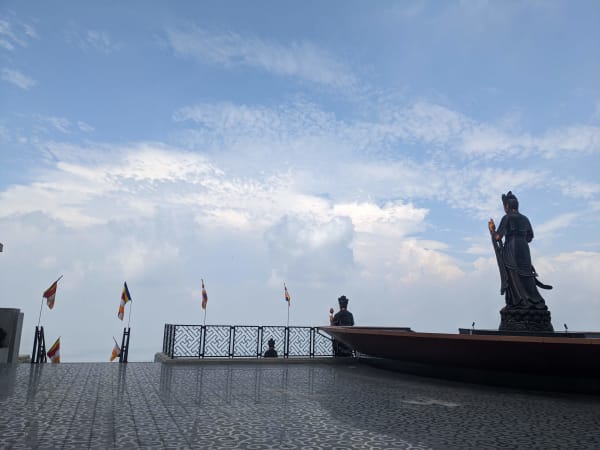
  • 72-metre bronze Lady Buddha (Tượng Phật Bà Tây Bổ Đà Sơn) - inaugurated early 2021, cast from over 170 tons of copper using European high-pressure metal-forming techniques. Record holder for the tallest bronze Buddha statue atop a mountain peak in Asia.
  • 36-metre Maitreya Buddha - built from over 6,600 interlocking sandstone blocks (5,112 tonnes total), installed in 2024. Faces east toward Dầu Tiếng Lake, a reservoir supplying fresh water to Ho Chi Minh City and surrounding provinces.

The summit complex today also includes a four-storey exhibition hall with a 3D mapping and hologram show, flower gardens, restaurants, and a telecommunications relay station.

Recent Addition

A smaller statue near the mountain's highest point was reportedly added in December 2025. Details are recent enough that local verification is recommended before relying on published guides.

Getting to Ba Den Mountain

Distance & Routes

Ba Den Mountain is in Thạnh Tân commune, about 11km northeast of Tây Ninh city and roughly 100km from Ho Chi Minh City - around 2.5–3 hours by car or motorbike depending on traffic.

Two routes run from HCMC via QL22A: turn right at Trảng Bàng onto TL782 for a shorter, direct approach; or turn left through Gò Dầu onto QL22B for a longer but wider, more scenic route passing the Vàm Cỏ Đông river and rice fields.

Transport Options
  • Private car or motorbike - most flexible, direct to the cable car base
  • Limousine vans (Lê Khánh, Lê Hải, Đồng Phước, Huệ Nghĩa, Saco): roughly 150,000–250,000 VND
  • Public buses (routes 703, 702, 5, 13, 94, 74 via Mộc Bài or Củ Chi): roughly 100,000–200,000 VND
Cable Car Lines
LineRouteDurationAdult Price
Chùa HangBase → Temple Complex~5 min150,000 one-way · 250,000 round-trip
Vân SơnBase → Summit~8 min400,000 round-trip only
Tâm AnTemple (Chùa Bà) → Summit~5 minSee Sun World site
Pricing Note

Cable car tickets are purchased separately from the 10,000 VND park entrance fee. A toboggan slide costs roughly 80,000–100,000 VND. Prices rise during Tết and major holidays - check the Sun World booking site or Klook before visiting.

Planning Your Day

A day trip from Ho Chi Minh City is feasible with an early departure by 6:30 AM. A full day comfortably covers the base temple complex, the summit, and optionally the Saturday lantern ceremony at dusk. Trekkers planning to camp near the summit should plan for two days and one night.

On the Ground

Ba Den Mountain has two distinct centres - and the more surprising discovery for most first-time visitors is that the summit, the part everyone photographs, isn't the spiritual one.

Temple Area (Chùa Hang Line)

The Chùa Hang cable car line descends to the temple complex about a third of the way up the mountain, centred on Linh Sơn Tiên Thạch Tự and the small cave shrine housing the Ba Den Goddess statue. This is the older, more devotional side of the mountain - where most Vietnamese pilgrims come specifically to make offerings and pray.


Summit Complex

The Vân Sơn cable car takes about 8 minutes to reach the summit, with views over Dầu Tiếng Lake opening up along the way. At the top: the 72-metre bronze Lady Buddha at centre, a four-storey exhibition hall running a 3D mapping and hologram show on the origins of the universe (plus models of 16 famous Vietnamese pagodas), the 36-metre Maitreya Buddha facing east over the lake, and the true summit marker a short walk further on.


Views

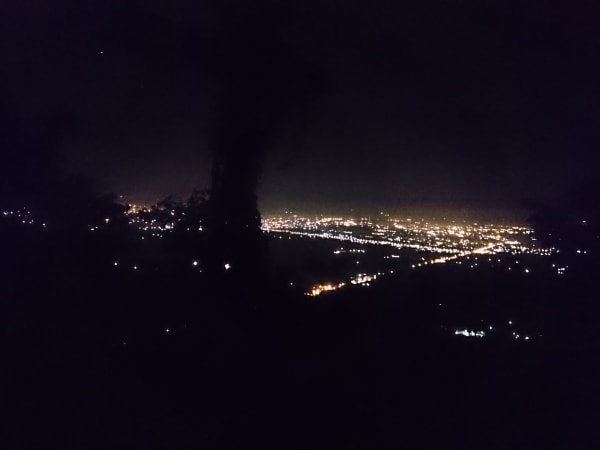
On clear days, the panorama is exceptional: the entire Tây Ninh plain below, the Cambodian border to the northwest, Dầu Tiếng Lake to the west, and the distant smudge of Ho Chi Minh City to the southeast. At night, city lights scattered across the plain look like stars fallen to the ground.


Saturday Evening Ceremony
Weekly Lantern Ceremony

Every Saturday evening, free lanterns are distributed from ~4 PM in the square beneath the Lady Buddha statue, with the ceremony beginning at dusk. The most heavily attended version falls on the 14th–15th of the 1st lunar month (Rằm tháng Giêng).


Trekking

The most common trekking route follows utility poles through genuine montane forest - orchids, fig trees, birds - taking roughly 3–5 hours. Many visitors combine cable car up with trekking descent (or vice versa). The trail can exit via the temple complex or by catching a cable car from one of the mid-mountain stations.

Registration Required

Independent trekking requires prior registration with local forest rangers and either an experienced guide or a registered tour operator. This is enforced - it is not optional.

Tips for Your Visit

Who Should Visit
  • Families and elderly visitors - cable car system handles most elevation gain; escalators reduce walking further in some temple and shrine areas
  • Pilgrimage and religious culture - one of the most significant folk religion and Buddhist pilgrimage sites in southern Vietnam, active year-round
  • Photography and scenic day trips - panoramic views over the Tây Ninh plain; best light 7–9 AM
Who This Doesn't Suit
  • Hardcore trekkers expecting a serious physical challenge - cable car development since 2020 has substantially changed the summit's character
  • Wilderness seekers - the summit is now a developed tourism complex; the genuine forest experience is in the descent, not at the top

This pattern - cable car development changing summit character - has repeated across Vietnam's tallest peaks: Bà Nà Hills, Chứa Chan, Fansipan. Something is lost in terms of quiet and personal achievement; something genuine is also gained in access for elderly visitors and people with limited mobility who couldn't otherwise reach these places.

Things People Often Miss
  • The spiritual heart of Ba Den is the cave shrine a third of the way up, not the summit - most Vietnamese pilgrims come specifically for the Ba Den Goddess, not the large statues
  • A 'sea of clouds' sometimes forms below the summit around 6–8 AM if it rained the previous evening - not guaranteed, but worth an early arrival if conditions look right
  • The summit runs 8–10°C cooler than the base and gets foggy from ~5 PM - bring a jacket even on a hot day below
If the Pilgrimage Side Matters

Spend real time at Linh Sơn Tiên Thạch Tự rather than rushing straight to the summit - this is where most of the actual devotional activity happens throughout the day. The combination of Ba Den with a visit to the Cao Dai Great Temple in Tây Ninh town (noon ceremony at 12:00 PM) makes a logical and contrasting full-day itinerary from Ho Chi Minh City.

Suggested Day Itinerary

Depart HCMC by 6:30 AM → arrive mountain ~9 AM → Chùa Hang cable car to temple complex (1–1.5 hours) → Vân Sơn cable car to summit (2–3 hours) → lunch at summit restaurants → descend by cable car or trekking trail → return to HCMC, or continue to Tây Ninh city for the Cao Dai Great Temple.

Festival Crowds

Tết, Hội Xuân núi Bà (4th day of the 1st lunar month through the whole month), and the Vía Bà festival (3rd–6th day of the 5th lunar month) bring very large crowds. Keep valuables close - pickpocketing has been reported. Book cable car tickets in advance on Klook or the Sun World site to skip long queues.

Based on real traveler experiences and commonly mentioned advice from multiple visitors.

Book tickets via Klook or the official Sun World site in advance to avoid long queues, especially on weekends and holidays
Bring water, snacks, and a jacket for the cooler summit temperatures; buffet restaurant pricing on-site is high and quality can be inconsistent during peak hours
Visit on weekdays to avoid crowds; if visiting on a Saturday, time your visit to catch the evening lantern ceremony beneath the Lady Buddha statue
Cable car pricing (separate from the 10,000 VND entrance fee) runs on three lines: Chùa Hang (base to the temple complex) costs 150,000 VND one-way or 250,000 VND round-trip per adult; Vân Sơn (base to the true summit) is round-trip only at 400,000 VND per adult; Tâm An (Chùa Bà to the summit) connects the two. A toboggan/slide ride costs roughly 80,000-100,000 VND. Prices rise around Tet and other holidays - check the official Sun World booking site or Klook before visiting
First-timers only need the Vân Sơn cable car line (base to summit) - it reaches the highest point, the best panoramic views, and the full wind-and-cloud experience in one ride. Save the Chùa Hang line for a future visit if you're short on time and more interested in scenery than temple-hopping; the Tâm An line through the forest is a nice bonus but not essential
The summit is frequently cloud-covered in the morning - arriving by 9:00 AM on dry season days gives the best chance of clear views across the Tay Ninh plain to Cambodia. Go too late and you'll get harsh sun, bigger crowds, and harder photos; go between 7-9 AM for the softest light and thinnest crowds, or after 4 PM for fog and sunset, though arriving that late leaves little time to look around
A 'sea of clouds' sometimes forms below the summit around 6-8 AM - most likely if it rained the previous evening and the following morning is clear. Not guaranteed, but worth an early arrival if the conditions look right
The mountain is an active pilgrimage site - weekends and Vietnamese holidays bring very large crowds, especially around Tet (Hội Xuân núi Bà runs from the 4th day of the 1st lunar month through the whole month) and the Vía Bà festival (night of the 3rd through the 6th day of the 5th lunar month). Weekday visits are significantly quieter
Keep your belongings close during festival periods - pickpocketing opportunists are known to target the crowds
Ba Den is most famous for the Ba Den Goddess legend: Lý Thị Thiên Hương, a young woman who died protecting her honour while her fiancé was away at war, and was later found and reburied by a monk who named her 'Nàng Đen' (the Dark Lady) out of respect - the name later softened to 'Bà Đen'. Her small stone statue, said to weigh around 240kg, is enshrined in a cave at the Linh Sơn Tiên Thạch Tự temple complex about a third of the way up, and this - not the summit statues - is the spiritual heart of the mountain for most Vietnamese pilgrims
Don't skip the summit statue complex: a 72-metre bronze Lady Buddha (Tượng Phật Bà Tây Bổ Đà Sơn) - a record holder for tallest bronze Buddha statue on a mountain peak in Asia - stands at the centre, with a 36-metre sandstone Maitreya Buddha statue aligned nearby overlooking Dầu Tiếng Lake, the reservoir that supplies fresh water to Ho Chi Minh City and nearby provinces. A newer, smaller statue near the highest point was added in December 2025 - worth confirming current details locally, since it postdates most published guides
Every Saturday evening, a lantern-offering ceremony (dâng đăng) takes place in the square beneath the Lady Buddha statue - free lanterns are handed out from around 4 PM, with the ceremony itself starting at dusk. The main, most heavily attended version falls on the 14th-15th of the 1st lunar month (Rằm tháng Giêng)
The summit is noticeably colder than the base - typically 8-10°C cooler - and gets foggy from around 5 PM onward. Bring a jacket even if it's hot at the bottom of the mountain
Cable car cabins can be windy and shaky in the early morning, and motion sickness bags are provided inside - worth knowing if you or anyone in your group is prone to motion sickness or afraid of heights
Wear proper shoes for the trek - the trail is steep and rocky in sections, and the forest canopy keeps the path damp even in dry season. Trekking requires prior registration with the local forest ranger station and either an experienced guide or a registered tour operator - this isn't optional
Book cable car tickets in advance through Klook or the official Sun World site if visiting on a weekend or holiday, to skip long queues at the ticket counters

Common questions from travelers who've visited this place.

When is the best time to visit?
Visit early morning (7-9 AM) on weekdays for the softest light, thinnest crowds, and best chance of clear views or a 'sea of clouds' below the summit. Avoid holidays and weekends if you want a quieter visit.
What footwear should I wear?
Proper closed-toe shoes required for climbing sections. Sandals and flip-flops prohibited. Comfortable athletic shoes recommended, and proper trekking shoes if you're hiking rather than taking the cable car.
How long does the visit take?
A full day covering the base temple, the summit complex, and the Saturday lantern ceremony needs 8-10 hours. A summit-only visit for photos and views can be done in 3-4 hours. Trekkers planning to camp overnight near the summit should allow two days and one night.
What are the giant statues on top of Ba Den Mountain?
The centrepiece is a 72-metre bronze Lady Buddha (Tượng Phật Bà Tây Bổ Đà Sơn), record holder for tallest bronze Buddha statue atop a mountain peak in Asia, installed in 2021. A 36-metre sandstone Maitreya Buddha was added in 2024, facing Dầu Tiếng Lake. These are separate from the small Ba Den Goddess statue at the temple a third of the way up, which is the older and more spiritually significant site for most Vietnamese pilgrims.
Which cable car line should I take?
First-time visitors generally only need the Vân Sơn line, running directly from the base to the summit. The Chùa Hang line suits those more interested in the pilgrimage side, and the Tâm An line (temple to summit through forest) is a scenic bonus.
Is Ba Den worth visiting if I'm not religious?
Yes - the summit views, the scale of the modern Buddhist statues, and the cable car ride are worthwhile on their own as a landscape and photography destination, independent of any spiritual interest.
Can I trek up and take the cable car down (or vice versa)?
Yes. Many visitors take the cable car up and trek down through the forest (roughly 1.5-2 hours), or trek up via the utility-pole route (3-5 hours) and ride the cable car down. Independent trekking requires prior registration with local forest rangers and an experienced guide or registered tour.