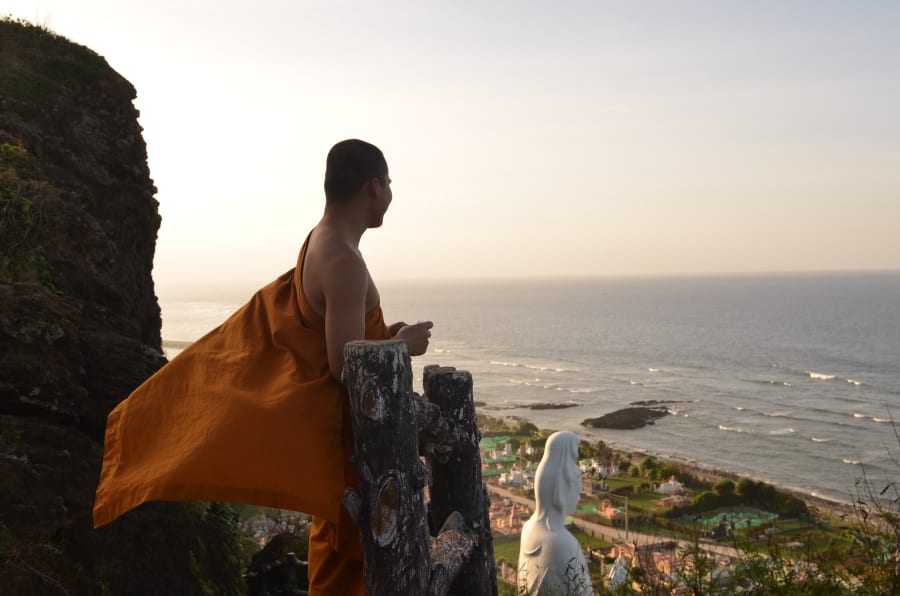
How centuries of trade, migration and cultural exchange shaped the temples of a country at Asia's crossroads.
Most travelers can recognize Chinese architecture when they see it. Most can also recognize the religious and architectural traditions that spread from India across South and Southeast Asia. But what happens when those two worlds meet - not directly, but through centuries of trade, migration, and kingdoms rising and falling between them?
Travel Vietnam from north to south. The temples will show you.
The Question Nobody Asks
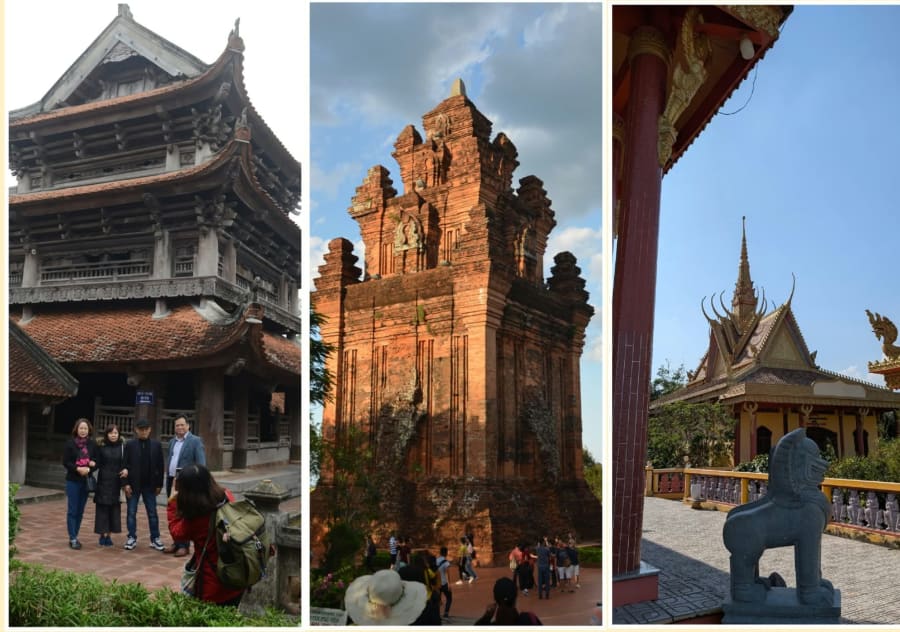
Walk into a traditional pagoda in Hanoi and you'll feel it immediately - the curved rooflines, the red lacquer columns, the smell of incense drifting past Chinese characters carved into wood. It feels East Asian in a way that's hard to articulate but impossible to miss.
Drive four hours south to My Son and you're in a completely different world. Ancient brick towers rise out of the jungle, carved with figures that have nothing to do with China. The vocabulary is Hindu - gods, serpents, lotus flowers, the geometry of temples built toward the sky rather than around a courtyard.
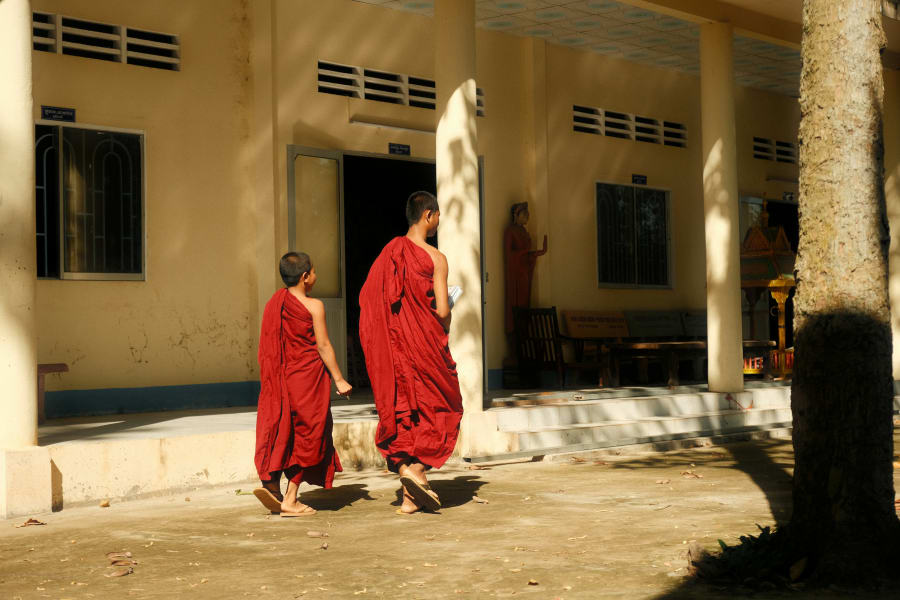
Then go further. Drop into the Mekong Delta. Pull up outside a Khmer temple in Soc Trang or Tra Vinh. The roof is tiered and swooping, painted gold and deep red. A naga - the sacred serpent - runs the length of the entrance staircase. The monks inside wear saffron robes. The Buddhism practiced here is Theravada, the same tradition you'd find in Cambodia, Thailand, Myanmar.
Three buildings. One country. Three completely different architectural languages.
This isn't an accident. It's geography.
Why Vietnam Looks the Way It Does
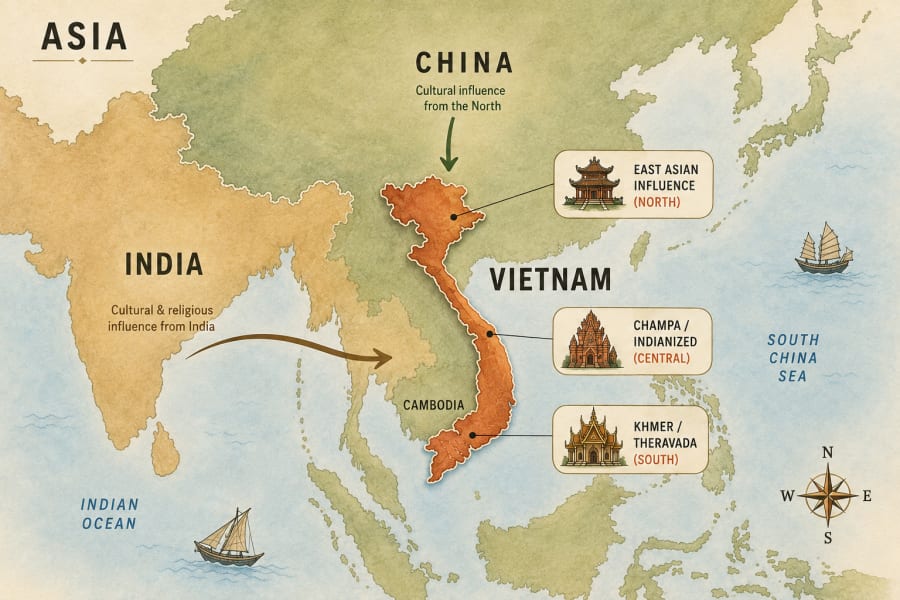
Vietnam occupies a remarkable position on the map of Asia.
To the north: China, whose cultural influence spread south for more than a millennium. To the west: the highlands of mainland Southeast Asia. Along the coast: a long shoreline that placed Vietnamese coastal societies within maritime networks connecting China, mainland Southeast Asia and the wider Indian Ocean world.
For centuries, this geography made Vietnam a meeting ground - for merchants, monks, migrants, and armies. People moved through it. Ideas moved with them.
China's influence came from the north, directly and repeatedly. Vietnam spent more than a millennium under successive periods of Chinese rule, and even after independence in 938 CE, Chinese culture continued to shape northern Vietnamese society - its writing system, its political structures, its Buddhist traditions, its architecture.
Indian religious influence often reached Vietnam through Southeast Asian societies that had already adapted Indian religious traditions - particularly Champa, the maritime civilization whose coastal centers stretched across much of what is now central and south-central Vietnam, and the Khmer world that shaped the Mekong Delta. These societies had absorbed Indian religions, art, and architectural traditions centuries earlier, adapted them into something distinctly Southeast Asian, and passed them onward.
The result is a country where the dominant cultural influence shifts as you move from north to south - and where centuries of overlap, absorption, and local adaptation have created something that is none of those things entirely.
It is distinctly Vietnamese.
North: The East Asian World
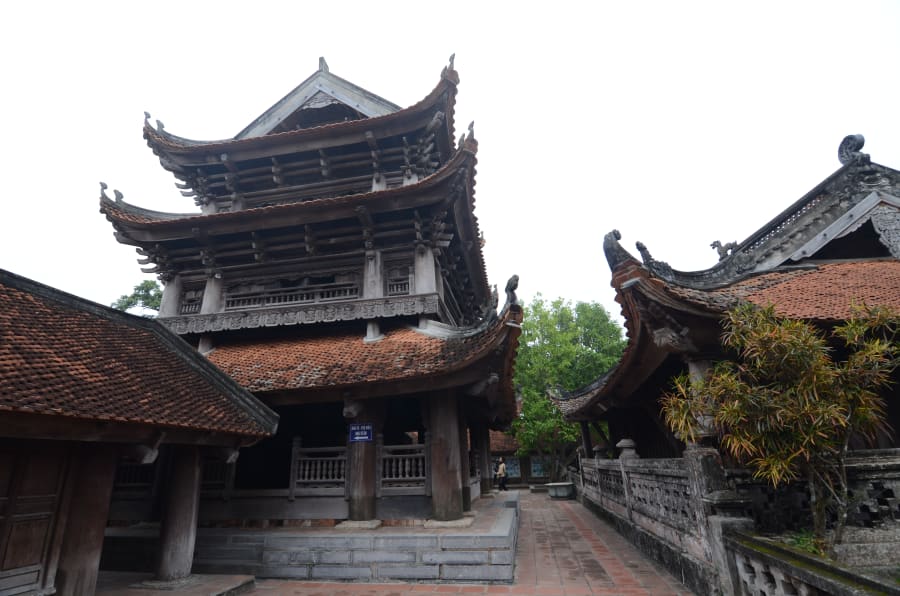
The pagodas and communal houses of northern Vietnam speak a recognizable architectural language - one shaped by more than a thousand years of proximity to China.
Curved roofs, timber structures, lacquered wood, courtyards, dragons and phoenixes, and Chinese characters are all part of a visual vocabulary shared across the broader East Asian cultural sphere. But Vietnamese builders and communities adapted that vocabulary to local religious and social traditions. The result is architecture that feels East Asian without being Chinese.
The dinh - the traditional communal house found across northern Vietnamese villages - is perhaps the clearest example. It draws on East Asian spatial concepts but serves a distinctly Vietnamese social function: housing the village guardian spirit, hosting community gatherings, anchoring local identity. The form arrived from one direction. What Vietnamese people made of it was their own.
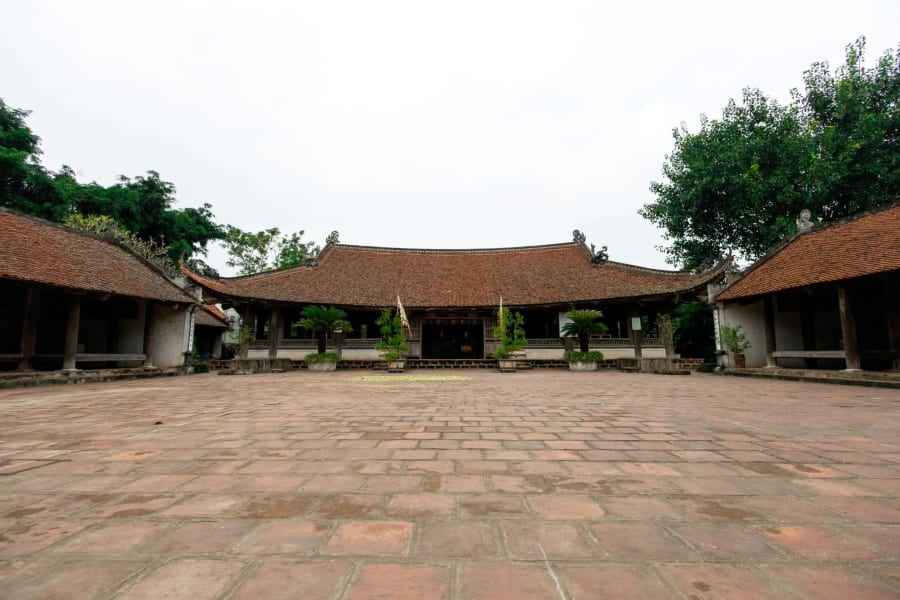
Where to see it:
- Chua Keo (Thai Binh) - one of the best-preserved examples of traditional northern Vietnamese pagoda architecture
- Chua But Thap (Bac Ninh) - 17th century, considered a masterpiece of Sino-Vietnamese Buddhist architecture
- Van Mieu, Hanoi - the Temple of Literature, modeled on Confucian temple design but deeply Vietnamese in its meaning
Central Vietnam: The Champa Legacy
This is where the story gets interesting.
For much of the first millennium CE, central Vietnam was home to the Champa polities rather than the Dai Viet state. Champa was a maritime civilization whose coastal centers and trading ports connected it to networks stretching across the South China Sea and toward the Indian Ocean.
Champa was deeply shaped by Indian religions. Hinduism arrived through trade networks, carried by merchants and priests. The Cham people didn't simply copy Indian temples - they absorbed the religious traditions, the cosmological frameworks, the iconography, and created something architecturally distinctive: tall brick towers built with remarkably sophisticated masonry techniques, their surfaces covered in carved deities, their interiors housing sacred lingas and images of Shiva, Vishnu, and Brahma.
These towers still stand. And they look like nothing else in Vietnam.
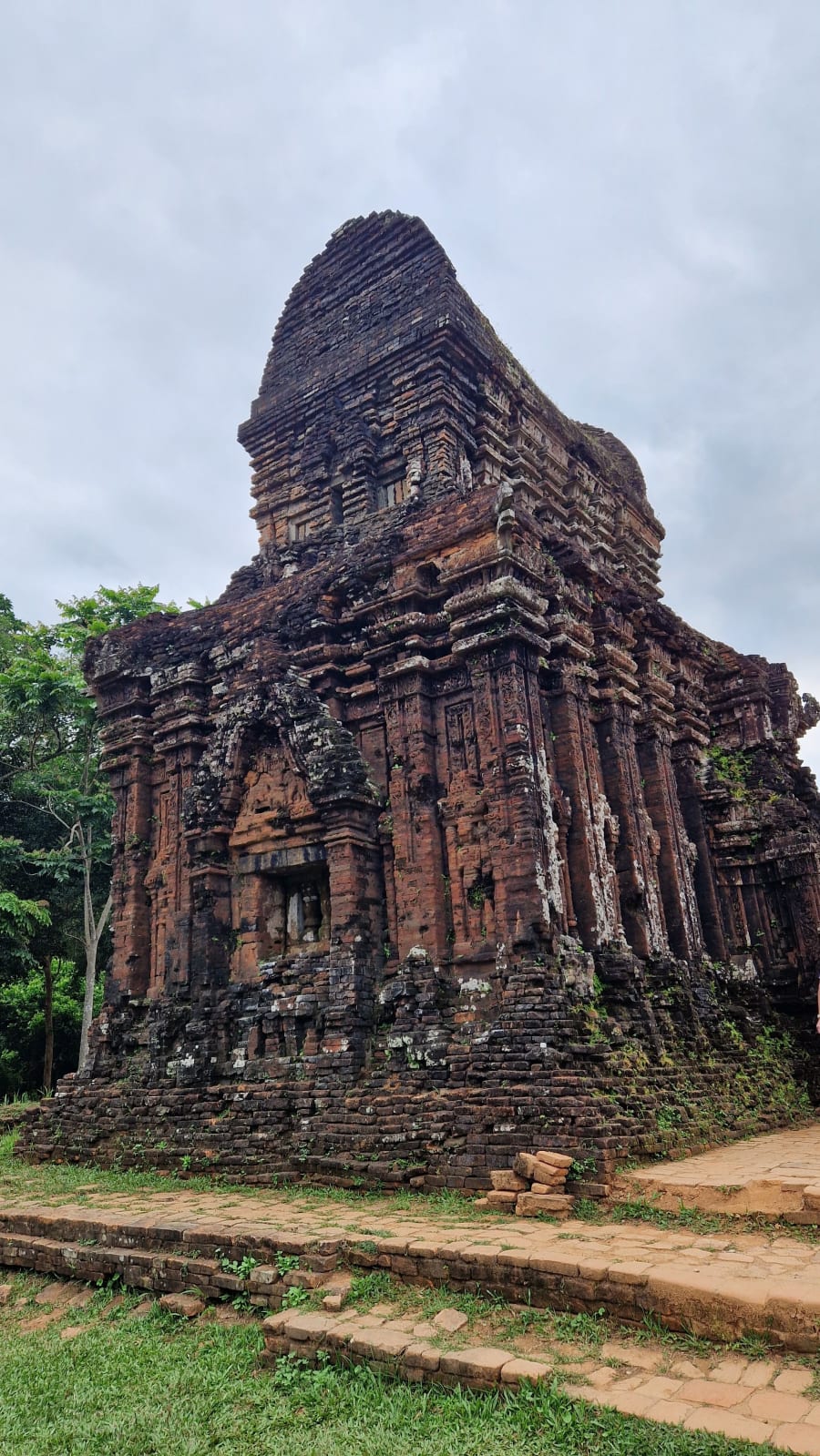
My Son, tucked into a valley in Quang Nam province, is the most significant surviving complex - a UNESCO World Heritage Site where dozens of towers were built between the 4th and 13th centuries. Po Nagar in Nha Trang has been in continuous use for over a thousand years, first as a Hindu temple, later adapted by Vietnamese Buddhists. The Cham towers of Binh Dinh, Ninh Thuan, and Binh Thuan rise from the landscape with an unmistakably different visual grammar.
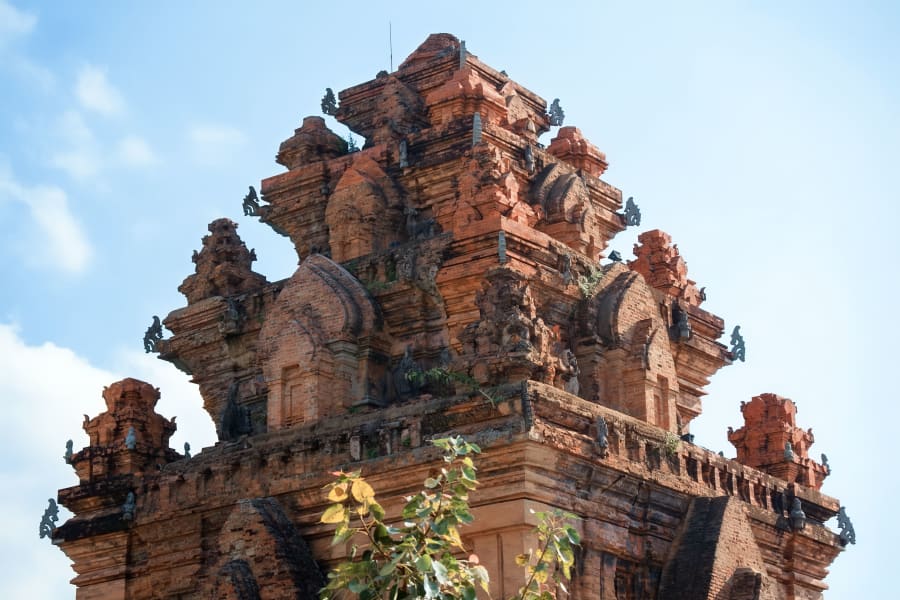
As Dai Viet expanded southward over the centuries, Champa's political territory was gradually absorbed into the emerging Vietnamese state. The process was neither simple nor culturally clean: populations moved, communities changed, and Cham traditions survived and evolved alongside Vietnamese ones. The towers remained. The sacred sites continued to be visited. The boundary between conqueror and conquered, in culture as in architecture, was never clean.
Where to see it:
- My Son Sanctuary (Quang Nam) - the most complete surviving Cham temple complex
- Po Nagar Towers (Nha Trang) - 8th century, still used for worship today
- Po Klong Garai (Ninh Thuan) - among the best-preserved Cham towers in Vietnam, set dramatically on a rocky hill
South: The Khmer and Theravada World
By the time you reach the Mekong Delta, a very different cultural world comes into view.
The Mekong Delta has long been home to Khmer communities and was connected to Khmer political and cultural worlds before large-scale Vietnamese settlement expanded southward in the 17th and 18th centuries. The Khmer communities that remained didn't disappear - they built temples, maintained traditions, and created a religious and architectural landscape that still exists today.
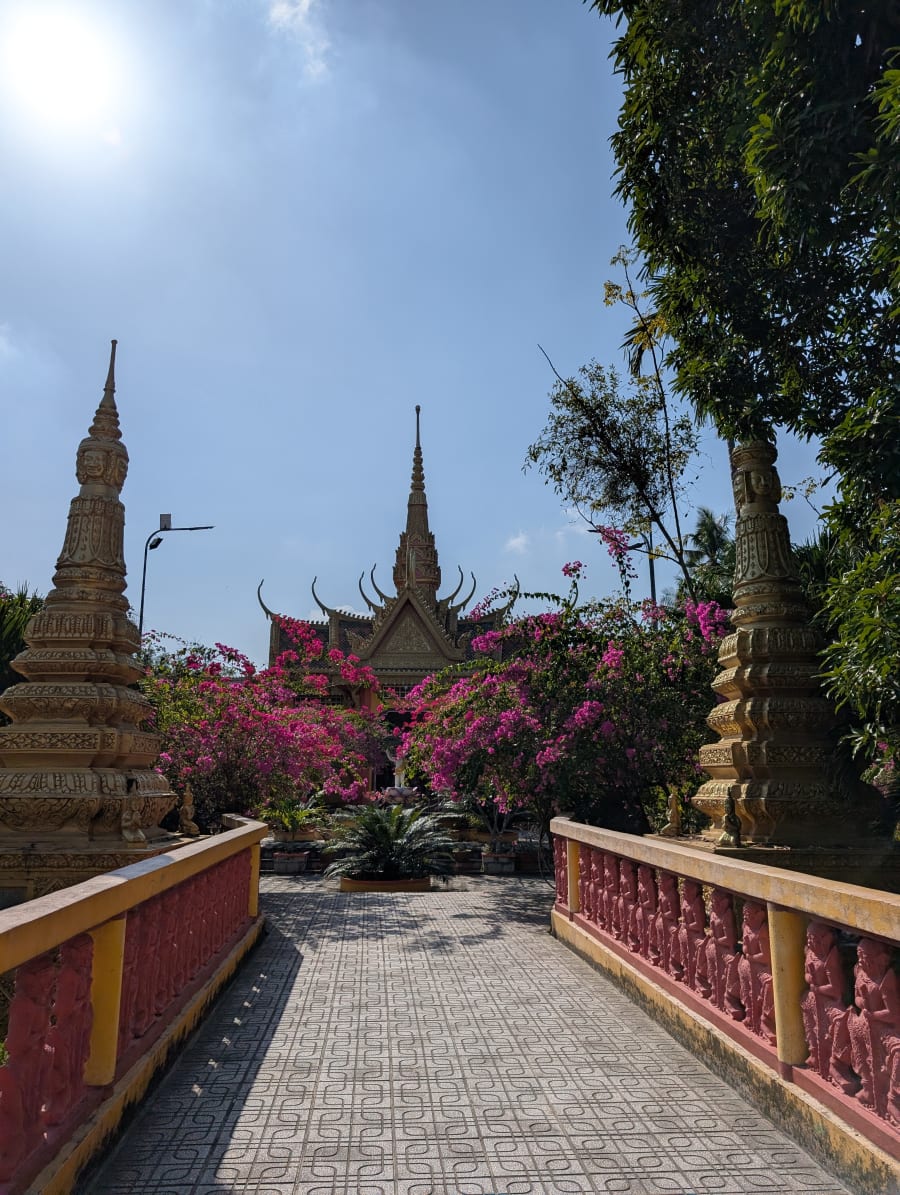
Khmer Theravada temples in the delta are immediately visually distinct from anything in the north. The roofs are multi-tiered and steeply pitched, often painted in vivid gold, red, and green. Nagas - the sacred serpents of Khmer Buddhist tradition - run along staircases and gateway rooflines. The interior spaces are organized differently: monks' quarters, teaching halls, and worship spaces arranged around the grounds in ways that reflect the Theravada monastic tradition.
The Buddhism practiced here is Theravada - the tradition that spread from Sri Lanka through mainland Southeast Asia, and which is the dominant form in Cambodia, Thailand, Laos, and Myanmar. Walk inside a Khmer temple in Soc Trang and the chanting, the robes, the ritual objects all belong to a tradition that connects these communities to a much wider Buddhist world - one that has little to do with the Mahayana Buddhism of the north.
Where to see Khmer architecture:
- Chua Doi / Mahatup Pagoda (Soc Trang) - one of the most important Khmer temples in the delta, with a famous colony of fruit bats in its grounds
- Chua Kleang (Soc Trang) - 16th century Khmer temple, among the oldest in the region
When the Mixing Becomes a Religion: Cao Dai
Before leaving the south, there is something worth considering that goes beyond architecture entirely.
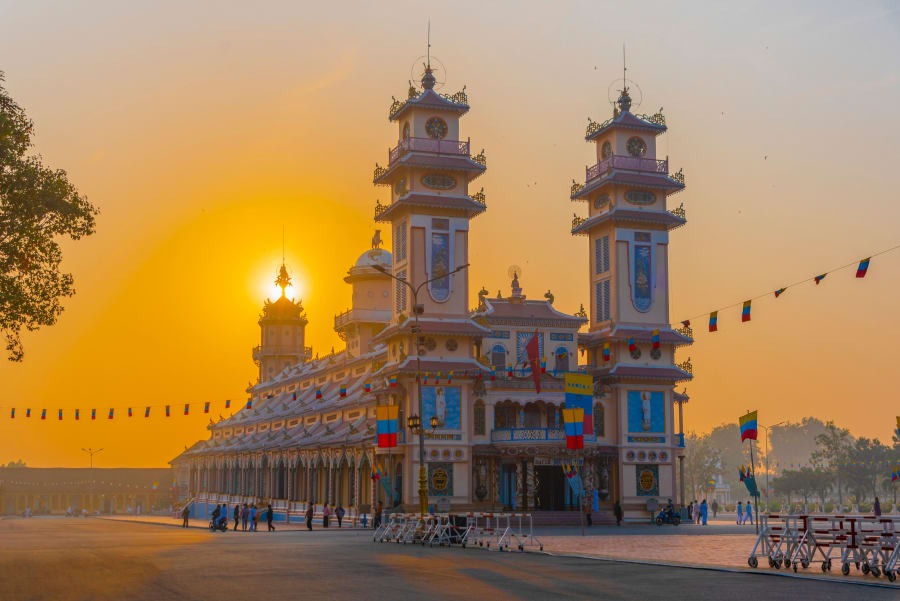
The Cao Dai Holy See in Tay Ninh is not a temple shaped by outside influences. It is a temple built by a religion that Vietnam itself invented.
Founded in 1926, Cao Dai deliberately brought together elements of Buddhism, Taoism, Confucianism, Christianity, and indigenous Vietnamese beliefs - and wove them into something entirely new. Look at the architecture: the towers have a vaguely Gothic silhouette, the interior columns are wrapped in dragons, the color palette is unlike anything in East or Southeast Asia. It is visually overwhelming in the best possible way.
If the north-central-south framework shows how outside cultures shaped Vietnam, Cao Dai shows what happens when Vietnam takes all of that and builds something from scratch. The result isn't Chinese. It isn't Indian. It isn't French. It is something that could only have come from this particular country, at this particular crossroads, after this particular history.
That is perhaps the most Vietnamese thing of all.
Where to see Cao Dai:
- Cao Dai Holy See (Tay Ninh) - the most visually striking religious building in Vietnam, and the clearest example of what happens when a culture absorbs many influences and creates something entirely its own
What Vietnam Made of All of It
None of these influences arrived cleanly. None stayed unchanged.
Chinese architectural traditions were absorbed into Vietnamese village life and reshaped around local religious practices. Cham Hindu temples were built by a people who had spent centuries adapting Indian cosmology into something Southeast Asian. Khmer Theravada temples in the delta exist alongside Vietnamese Mahayana pagodas and Chinese community temples, each with its own congregation, in towns where these communities have lived side by side for generations.
Vietnam didn't simply receive cultures from north and south. It transformed them.
The northern pagoda is not a Chinese temple. The Cham tower is not an Indian temple. The Khmer temples of the Mekong belong to the Khmer cultural and Theravada Buddhist tradition, while their history in Vietnam has developed within a distinctly Vietnamese context. Each is something that happened here, shaped by the people who built it, the landscape they built it in, and the history that brought those influences to this particular stretch of coast and river delta.
This is what makes Vietnamese religious architecture worth looking at slowly, rather than quickly.
A Note Before You Go
The framework in this piece - north, central, south - is a simplification. Vietnam's cultural geography is more layered than any three-part model can capture. Chinese diaspora communities brought Fujian and Cantonese temple traditions to Hoi An, Cho Lon, and cities across the country. The imperial architecture of Hue is its own category. Dao Mau - the Vietnamese Mother Goddess tradition - runs through the north in ways that are neither Chinese nor Buddhist. Indigenous highland traditions add further layers throughout.
What the north-central-south framework offers is a starting point: a way of noticing differences that are genuinely there, and asking why they exist.
The answer often begins with geography.
Vietnam's temples are more than religious buildings. They are a map of the country's geography and history - showing how people, religions, and ideas moved across Asia, met here, and became something new.
That is worth seeing for yourself.
Sources & Further Reading
My Son and Champa
- UNESCO World Heritage - My Son Sanctuary
- Hardy, A., Cucarzi, M., & Zolese, P. (2009). Champa and the Archaeology of My Son, Vietnam. NUS Press
Khmer architecture and communities in Vietnam
Cao Dai
Buddhist traditions
Vietnam as a cultural crossroads