Menu
DestinationsLocationsBlogMapAbout
📍 temple · heritage · history · cultural · landmark · ha noi

Temple of Literature

The Temple of Literature in Hanoi is Vietnam's best-preserved example of traditional Vietnamese architecture - a Confucian temple complex built in 1070 that served as the country's first university for over 700 years, with five courtyards of pavilions, ponds, and stone steles recording the names of doctoral graduates.

🏛️ Vietnam's First University📸 Architecture🇻🇳 National Heritage🎓 Confucian Temple
🧭 Get Directions
Best Time to Visit
📅 Oct – Apr (cool and dry; avoid summer heat and rain)
Entry Fee
🎟️ Adults 70,000 VND; children under 16 free; audio guide (foreign language) 100,000 VND
Opening Hours
🕐 Tue – Sun 8:00 – 17:00 (closed Monday)
Address
📌 Quốc Tử Giám, Đống Đa, Hà Nội
👥Crowds
Weekday mornings are quietest. Tour groups peak from mid-morning. Graduation season brings professional photo shoots that occupy entire courtyard sections. Tết brings student visitors praying for exam success.
🌤️Seasonal
Oct–Apr is the most comfortable visiting period. Early spring around Tết has a festive atmosphere with decorations, but also higher visitor numbers.

What Makes Temple of Literature Special

The Temple of Literature (Văn Miếu - Quốc Tử Giám) was founded in 1070 under Emperor Lý Thánh Tông as a temple dedicated to Confucius, then expanded six years later to include the Quốc Tử Giám - Vietnam's first national university. For the next 700 years, under the Lý, Trần, and Lê dynasties, this compound trained the scholars and mandarins who administered the country. Entry was through the imperial examination system: three tiers of exams - regional (hương), national (hội), and palace (đình) - that filtered candidates across years of study. The French colonial administration dismantled that system in the early 20th century and replaced it with Western-style education. The physical complex survived largely intact and remains the best-preserved example of traditional Vietnamese architecture in Hanoi. The 82 stone doctoral steles, recording the names of 1,300 graduates between 1484 and 1779, are listed by UNESCO as a Memory of the World heritage document.

🚗 Getting There

The Temple of Literature is in Đống Đa district, about 2km southwest of Hoàn Kiếm Lake. Walking from the Old Quarter takes 25-30 minutes through the French Quarter. Grab or taxi from Hoàn Kiếm is around 10 minutes. Several bus routes run along Quốc Tử Giám street. The main entrance is on Văn Miếu Street, clearly signed. Motorbike parking is available on surrounding streets.

👀 On the Ground

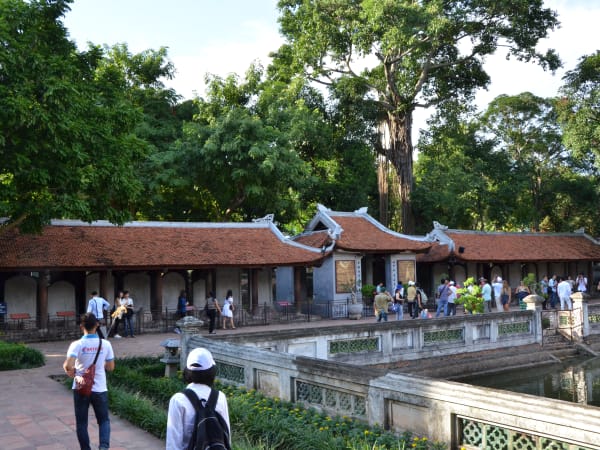
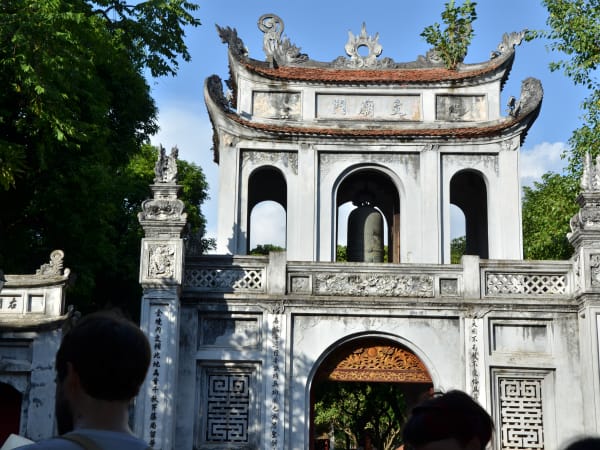
Five successive courtyards, each passed through a gate, moving from the street entrance to the inner sanctuary. The first two courtyards are landscaped gardens. The second holds the Khuê Văn Các pavilion - Hanoi's city symbol, depicted on the 100,000 VND banknote. The third courtyard has the Thiên Quang Tĩnh reflecting pool and the 82 doctoral steles. The fourth holds the main Confucius temple. The fifth contains the reconstructed Thái Học hall. Budget around 2 hours to move through everything at a pace that lets you read the panels and take in the context - not just the architecture.

🧳 Tips

Văn Miếu carries real weight for Vietnamese people - this is not a decorative heritage site but a place with direct cultural meaning around education, achievement, and national identity. That context shapes how to behave here: the rules around dress and not touching the steles aren't bureaucratic formalities. Beyond the cultural dimension, it's also one of the few places in Hanoi where you can stand in front of a primary historical document - actual names of actual scholars, carved in stone in the 15th century - rather than a reconstruction or a replica. If you're treating Hanoi as more than a checklist, this is where to spend time.

Based on real traveler experiences and commonly mentioned advice from multiple visitors.

Allow 2 hours to move through all five courtyards properly. 3 hours if you want to read the full context panels on the steles and exhibition rooms.
Do not touch the tortoise heads on the steles - it's prohibited, there are guards and cameras, and it damages the stone. The 'good luck before exams' tradition has visibly worn the stone.
Dress modestly - no bare shoulders, crop tops, or short shorts. This is a place of active cultural significance for Vietnamese visitors, not just a photo stop.
Give yourself about 2 hours here - long enough to move through all five courtyards without rushing and actually read the context panels. This is a site where slowing down pays off.
Walk in and try to picture it as a working institution: this was Vietnam's first national university, operating for 700 years. Students here were preparing for three rounds of imperial examinations - the regional (hương), national (hội), and palace (đình) exams - a system that determined who ran the country.
The 82 stone steles in the third courtyard are the most important objects on the site. Each one records the names, hometowns, and results of doctoral graduates from 1484 to 1779, mounted on stone tortoise bases. These are UNESCO Memory of the World documents - actual primary records, still legible after 500 years.
Do not touch the tortoise heads. Many Vietnamese believe rubbing them before an exam brings luck, and the stone has worn smooth in places from centuries of hands. The practice is officially banned - there are guards and cameras - and beyond the rules, it accelerates damage to an irreplaceable heritage site.
Dress modestly. This is an active place of reverence for many Vietnamese, not just a photo location. No bare shoulders, short shorts, or crop tops.
Arrive before 9 AM on weekdays to have the courtyards to yourself. By mid-morning, tour groups fill the main areas. Graduation season brings professional photo shoots with lighting rigs that take over entire sections.
The fifth courtyard - the Thái Học house - was reconstructed in 2000. The original was destroyed during the French colonial period. Worth knowing before you read too much into the 'ancient' atmosphere there.
The Khuê Văn Các pavilion in the second courtyard is Hanoi's official symbol and appears on the 100,000 VND banknote. It photographs best in morning light from the front gate side.

Common questions from travelers who've visited this place.

What is the entrance fee?
70,000 VND for adults. Children under 16 enter free. Audio guide in foreign languages is 100,000 VND extra. Buy tickets at the main gate - minimal queues on weekdays.
How long should I spend here?
2 hours is the right amount for most visitors - enough to cover all five courtyards without rushing and actually engage with what you're looking at. Budget 3 hours if you want to spend time with the stele inscriptions and exhibition content.
What was the imperial examination system?
The Quốc Tử Giám trained candidates for three tiers of exams: the regional (hương), national (hội), and palace (đình) exams. Passing all three was the path to senior government positions. The 82 steles record the names of those who made it through the final round - roughly 1,300 people across nearly 300 years.
Explore more
ha noi - Full Guide
View destination guide →