Menu
DestinationsLocationsBlogMapAbout
📍 cultural · town · sapa

Cat Cat Village

Cat Cat Village sits 2-3km below Sa Pa town in a steep valley - a Black H'mong settlement with traditional stilt houses, a waterfall once used for a French colonial hydro station, and stone-paved paths through terraced fields. Heavily developed for tourism - honest expectations matter here.

🎎 H'mong Culture💧 Waterfall📸 Photography🚶 Walking Trail
🧭 Get Directions
Best Time to Visit
📅 Sep - Nov (golden rice terraces, cool weather - best). May - Sep (warm, sunny). Tết (Lunar New Year) for festivals and traditional performances.
Entry Fee
🎟️ 150,000 VND adult, ~70,000-80,000 VND child (1m-1.4m), free under 1m. Traditional costume rental: 50,000-150,000 VND/outfit.
Opening Hours
🕐 5:00 AM - 10:00 PM. Return to Sa Pa town before dark to avoid mountain road risk and night cold.
Address
📌 San Sả Hồ, Sa Pa, Lào Cai
👥Crowds
Popular and heavily focused on tourist photography - busiest mid-morning to mid-afternoon. Early morning (7-9 AM) is noticeably quieter and has the softest light.
🥾Difficulty
Steep stone-paved stairs and paths, slippery when wet. Extensive walking required to cover the village and waterfall. Allow a half day rather than rushing.
⚠️Safety
Negotiate motorbike fares before agreeing - drivers commonly ask 100,000 VND round trip at the entrance. Wooden platforms/structures can be slippery from moisture - use designated viewpoints rather than improvised spots.
🚶Accessibility
Entrance fee 150,000 VND adult. Electric cart (10,000 VND, may require waiting) or motorbike (negotiate) available for the return uphill walk. Costume rental 50,000-150,000 VND. Open 5 AM-10 PM but return before dark.
🌤️Seasonal
Sep-Nov: golden rice terraces, cool comfortable weather - best overall. May-Sep: warm, sunny, good for general visits. Tết (Lunar New Year): festivals, folk games, traditional H'mong performances. Winter: cold, occasional fog.

What Makes Cat Cat Village Special

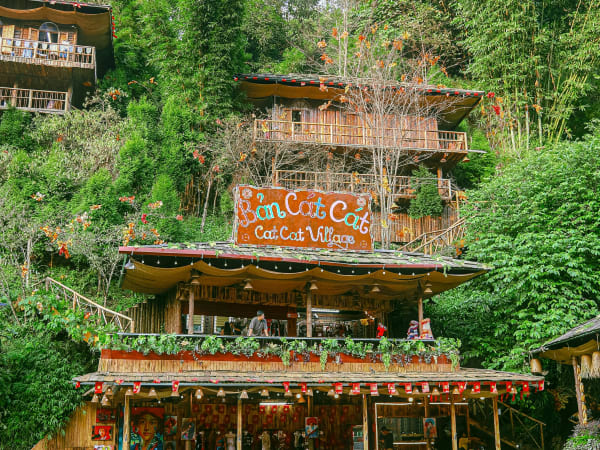
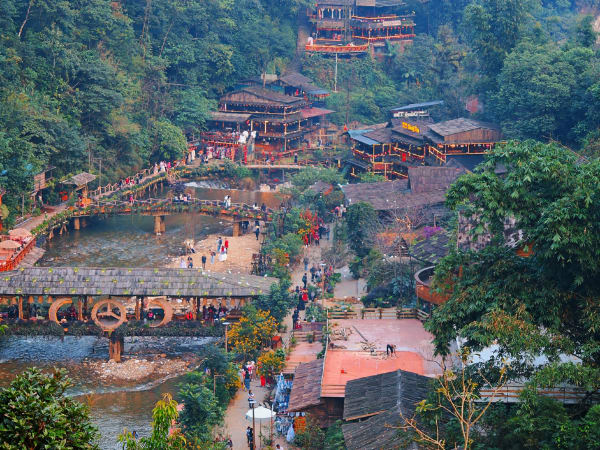
Cat Cat is the closest traditional village to Sa Pa town - 2-4km down a steep valley depending on the route taken, making it the easiest and most visited H'mong settlement in the area. It's a Black H'mong village with genuine roots: 19th-century stilt houses, terraced fields cut into the hillside, hand-loomed indigo textiles, and a waterfall that once powered a small French colonial hydro station, whose ruins remain visible today. The name itself carries a colonial echo - one theory traces it to the French word 'cascade' (waterfall), Vietnamized over time into 'Cát Cát'; another roots it in H'mong language meaning 'below the market'. The honest picture: decades of tourism development have layered significant commercialization onto the original village - photo-op installations, souvenir stalls, costume rental booths, and curated viewpoints exist alongside the H'mong families who still genuinely live and farm here. Visitors expecting an untouched, quiet mountain village may find the reality more developed than anticipated; visitors expecting an accessible, scenic introduction to H'mong culture and terraced-field landscapes will find exactly that.

🚗 Getting There

Cat Cat Village is 2-4km from Sa Pa town centre depending on the route, easily reachable on foot downhill (20-30 minutes), by motorbike, or by xe ôm. The entrance is clearly signposted from Sa Pa's main road, with a ticket booth at the top of the village path. Most visitors walk down and either negotiate a motorbike ride back up, take the 10,000 VND electric cart, or walk the uphill return (15-20 minutes for fit walkers). From Hanoi to Sa Pa: bus (5-7 hours, operators include Hà Sơn Hải Vân, Sao Việt, Sao Vàng) or train to Lào Cai then onward transport (7-8 hours total), or self-drive motorbike.

👀 On the Ground

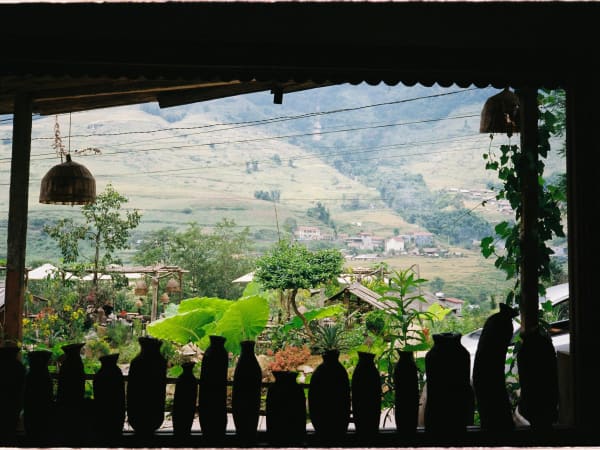
The path descends via stone-paved steps through the village past H'mong households, craft stalls, and terraced fields before reaching the valley floor and waterfall (also called Thác Tiên Sa). Large traditional water wheels turn slowly beside the clear stream; a small suspension bridge crosses near the falls. The route is well-maintained and wide enough for the tourist flow but genuinely scenic, framed by terraced fields above and forested slopes below. Local women sell hand-embroidered textiles, hemp cloth bags, and silver jewelry along the path - their sales pitches are gentle rather than aggressive. Traditional 19th-century stilt houses (nhà trình tường) are visible throughout, and craft demonstrations (weaving, dyeing, silver work) happen at stalls along the route. The waterfall itself drops through a gorge and is photogenic, with French colonial hydro station ruins nearby.

🧳 Tips

Cat Cat is Sa Pa's most accessible village introduction - good for families, first-time visitors, or anyone with limited trekking ability, but go in with realistic expectations about the level of commercialization. It's significantly more developed than Lao Chải or Tả Van deeper in Mường Hoa Valley, though that doesn't make the H'mong presence inauthentic - families here genuinely live and work in the village. If you want deeper cultural immersion with less commercial overlay, use Cat Cat as a half-day warm-up and continue trekking down into Mường Hoa Valley toward Lao Chải and Tả Van. September-November gives the best combination of golden terraced fields and comfortable temperatures; Tết (Lunar New Year) brings traditional festivals, folk games, and H'mong performances that add genuine cultural texture.

Based on real traveler experiences and commonly mentioned advice from multiple visitors.

Go in with realistic expectations - the village is heavily developed for tourism, not an untouched settlement
Morning (7-9 AM) for quiet and soft light; afternoon (3:30-5 PM) for golden hour and liveliness
Negotiate motorbike fares before agreeing, or use the 10,000 VND electric cart, or walk the uphill return
Wear sports shoes or low-heeled sandals for the steep, slippery stone steps
Sep-Nov for golden terraced fields combined with comfortable temperatures
Honest expectation check: Cat Cat is heavily touristified - many photo-op installations, souvenir stalls, and commercial setups exist primarily for check-in photos and shopping. If you're expecting a quiet, untouched village, you may be disappointed. The H'mong families here do genuinely live and work here, but the experience is commercialized.
The name 'Cat Cat' has two competing origin theories: (1) French colonists named it 'cascade' (waterfall in French), later Vietnamized to 'Cát Cát'. (2) In H'mong language, it means 'below the market' - referring to the waterfall's position below the village's old market area.
Morning (7-9 AM): village is quiet, soft light, fewer tourists, occasional morning mist on the road in - good chance of cloud-hunting on the way down.
Afternoon (3:30-5 PM): village is livelier with more commercial activity, golden light on the terraced fields, best for wide-angle photos of the whole valley. Good for sunset.
The French built a small hydro station here in the early 20th century, using the waterfall - the ruins are still visible near the falls today.
Traditional H'mong stilt houses (nhà trình tường) date back to the 19th century - three-room wooden structures with the kitchen in the middle room, living/dining space in front, bedrooms in back. Worth a slow look while walking through.
Traditional costume rental: 50,000-150,000 VND/outfit - popular for photos.
⚠️ Touts at the entrance often offer to guide you to 'free parking' but actually lead you to outside costume rental shops. These outside shops have fewer outfit choices, lower quality, and no support if something goes wrong. Skip them - go inside the village itself to rent costumes, get makeup done, and take photos. Better selection, better quality, and accountability if there's an issue.
Buy textiles, silver jewelry, and hemp cloth directly from H'mong women selling along the path - the most ethical way to take something home.
Wear sports shoes or low-heeled sandals - the stone-paved path is steep, narrow in sections, and slippery when wet.
Allow a half day to properly cover the village - the walk down, the waterfall, and the walk back (or motorbike/electric cart return) takes longer than it first appears given the stairs.
Negotiate hard if taking a motorbike back up - drivers at the entrance often ask 100,000 VND round trip; bargain, use the 10,000 VND electric cart (may require waiting for a full cart), or walk the 15-20 minute uphill return yourself.

Common questions from travelers who've visited this place.

Is Cat Cat Village worth visiting?
Depends on what else is on your Sa Pa itinerary. Yes, if this is your first H'mong village experience and you want an easy, scenic introduction close to town - the stilt houses, waterfall, and terraced fields deliver a genuine taste of highland culture with minimal walking required. No, if you've already trekked through Lao Chải or Tả Van in Mường Hoa Valley - those villages offer a less commercialized, more immersive experience, and Cat Cat's heavy tourism development will likely feel repetitive or underwhelming by comparison. As a half-day add-on before or after a longer Sa Pa trek, it's worth the time and entrance fee.
Is Cat Cat Village authentic or too touristy?
Both things are true simultaneously. The H'mong families here genuinely live, farm, and craft here - the stilt houses, weaving, and silver work are real traditions, not staged. But decades of tourism development have added significant commercial infrastructure: photo-op installations, souvenir stalls, costume rentals, and curated viewpoints. If you're expecting a quiet, untouched mountain village, you may be disappointed. If you want an accessible, scenic, reasonably authentic introduction to H'mong culture without serious trekking, Cat Cat delivers that well. For less commercialized village experiences, continue into Mường Hoa Valley toward Lao Chải and Tả Van.
Where does the name 'Cat Cat' come from?
Two competing theories. The first: early 20th-century French colonists were captivated by the village waterfall and named it 'cascade' (French for waterfall), which was gradually Vietnamized into 'Cát Cát'. The second: in H'mong language, the name means 'below the market', referring to the waterfall's position below the area's old market. Both explanations remain in circulation and neither is definitively confirmed.
Should I visit Cat Cat in the morning or afternoon?
Morning (7-9 AM): quieter, softer light, fewer tourists, occasional mist on the road in - better for a peaceful experience and portrait-style photos. Afternoon (3:30-5 PM): livelier atmosphere with more commercial activity, golden light on the terraced fields - better for wide-angle landscape photos and sunset. Both have merit depending on what you're prioritizing.
How long does it take to see Cat Cat Village?
Allow a half day. Unlike Tả Van or Lao Chải where you can ride a motorbike around, Cat Cat is primarily walked - steep stone stairs and swinging suspension bridges. The descent, waterfall visit, and return (on foot, by electric cart, or negotiated motorbike) takes longer than the short distance suggests. Budget 2-3 hours minimum, more if stopping for photos and shopping.
Explore more
sapa - Full Guide
View destination guide →