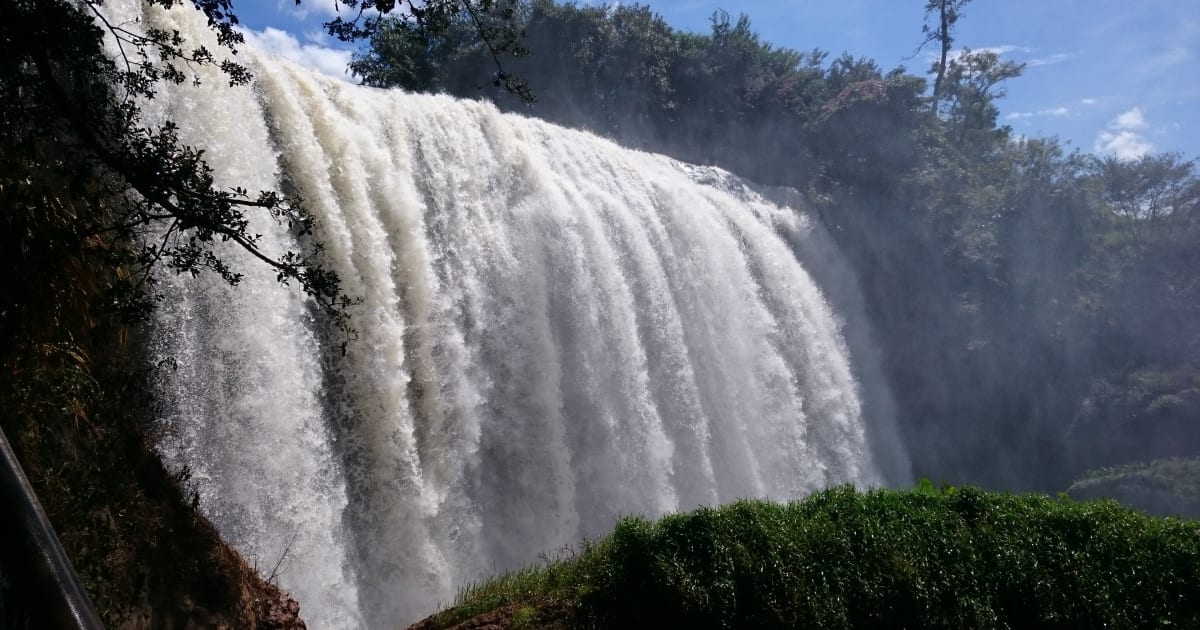
Elephant Waterfall - Thác Voi, also known by its K'Ho name Liêng Rơwoa - is a roughly 30-metre-tall, 40-metre-wide cascade on the Cam Ly stream in Gia Lâm area, Nam Ban town, Lâm Hà district, about 25-30km southwest of Đà Lạt via the Tà Nung Pass. The name has two explanations that locals give side by side: large rock formations at the base of the falls said to resemble a group of elephants, and the roar of the falling water, said to sound like elephants trumpeting; local K'Ho legend also ties the site to a story of elephants turned to stone and a mountain girl's devoted, unceasing song calling for her lost love.
Recognised as a national scenic site in 2001, the falls were historically reached via 145 winding steps - partly natural stone cut into the cliff face, partly small, precarious wooden bridge sections - continuing behind the cascade into two named caves, Hang Gió ('Wind Cave') and Hang Dơi ('Bat Cave'), an experience widely described by visitors who experienced it as one of the most memorable waterfall walks near Đà Lạt.
A residential area sits above the top of the falls, which takes away from the sense of untouched wilderness when viewed from certain angles, though photos taken from below looking up generally don't show it; the water can also turn muddy and reddish during heavy rain.
However, the site has been closed to direct visitor access for over 5 years (since around 2020-2021), after the province revoked the site's tourism investment licence amid unresolved legal and management issues; as of September 2026 - with a local update as recent as July 20, 2026 confirming the closure remains in force - authorities are still working to select a new investor, with no confirmed reopening date.
Chùa Linh Ẩn, a pagoda built in 1993 right beside the falls and home to one of Vietnam's tallest Quan Âm statues, remains open and offers the most reliable current view of the cascade from its terrace.