Menu
DestinationsLocationsBlogMapAbout
📍 pagoda · heritage · da lat

Linh Phước Pagoda

Linh Phước Pagoda - nicknamed 'Chùa Ve Chai' (the Bottle Pagoda) - in Trại Mát village is Vietnam's most elaborate ceramic mosaic temple, its surfaces built from millions of broken glass and ceramic fragments by artisans from Huế, with a record-holding 49-metre bell tower, a dragon sculpture built from roughly 12,000 recycled beer bottles, and an underground '18 Levels of Hell' exhibition.

⛩️ Ceramic Mosaic Pagoda🐉 Dragon Staircase📸 Photography🚂 Train Access
🧭 Get Directions
Best Time to Visit
📅 Year-round; morning for best photography light on the mosaics, and to arrive ahead of the tour buses
Entry Fee
🎟️ Free
Opening Hours
🕐 7:00 AM - 5:00 PM
Address
📌 120 Tự Phước, Trại Mát, Đà Lạt, Lâm Đồng
👥Crowds
Tour buses arrive from around 8:20 AM onwards. Extremely busy at midday, especially afternoons and weekends, with parking congestion from buses and vehicles on the temple grounds
⚠️Safety
Heavy vehicle and bus traffic directly on temple grounds creates unsafe pedestrian conditions at busy times. Cover shoulders and knees before entering certain buildings. Bicycle parking on-site closes at 5:30 PM
🚶Accessibility
Reachable by the tourist train from Đà Lạt station (about 30 minutes, commonly departing around 8:00 AM, round-trip about 170,000 VND) or by car, taxi, or motorbike. Trại Mát station to the temple is a 5-15 minute walk
🌤️Seasonal
Best in good weather; visit early morning before 10 AM to avoid crowds. Plan on 1.5-2 hours to see the complex properly

What Makes Linh Phước Pagoda Special

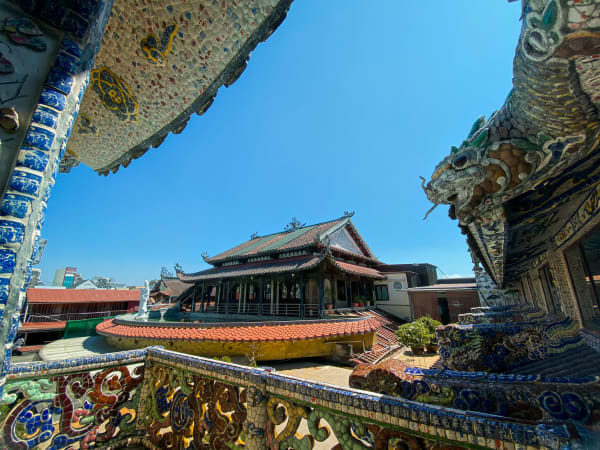
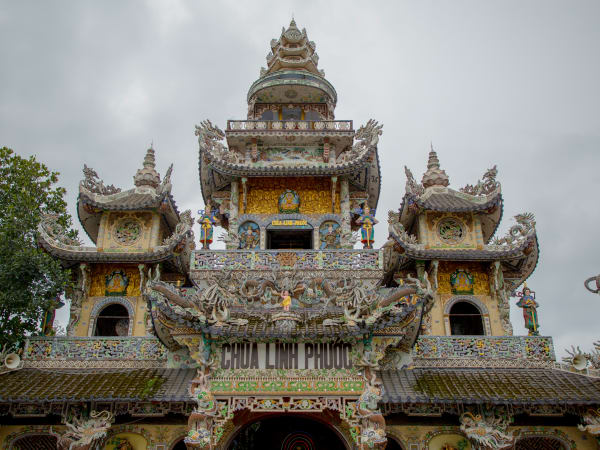
Linh Phước Pagoda - widely nicknamed Chùa Ve Chai, the 'Bottle Pagoda' - sits in Trại Mát village about 8-10km from central Đà Lạt, just off National Highway 20, and is the most visually extraordinary religious building in the Central Highlands. The entire complex is covered in mosaics assembled from broken glass, ceramic shards, and porcelain fragments: the main hall facade has dragons and phoenixes in vivid green, blue, and gold; the bell tower is encrusted with floral and figural patterns from base to top; a dragon sculpture beside the pond in the Long Hoa Viên area runs 49 metres long, its body built from roughly 12,000 recycled beer bottles set in concrete. The bell tower is also 49 metres tall over 7 storeys - a coincidence of measurement that echoes the number's significance in Buddhist tradition. This mosaic-inlay technique, known as khảm sành sứ, belongs to the same Vietnamese tradition that reached its imperial peak at Huế's royal tombs, particularly Khải Định Tomb - though where Khải Định showcased expensive imported Chinese and Japanese porcelain and French glass for an emperor, Linh Phước demonstrates how the same craft evolved using recycled beer bottles and broken ceramics donated by ordinary Buddhists. The pagoda was first built between 1949 and 1951, then substantially rebuilt and expanded from 1990 under the direction of its fifth abbot, Thượng Tọa Thích Tâm Vị, with funding from Buddhists across the country. Many of the craftsmen were brought from Huế, where generations of artisans had preserved the imperial porcelain-mosaic tradition developed for the Nguyễn court, and they worked from themes set by the monks rather than fixed architectural plans. The pagoda now holds 11 Vietnam Records, including for its bell tower height, a Buddha statue made from immortelle flowers, and the sheer scale of its mosaic-covered architecture.

🚗 Getting There

Linh Phước Pagoda is in Trại Mát village, roughly 8-10km northeast of Đà Lạt city, just off National Highway 20. The most atmospheric approach is by the tourist train from Đà Lạt Railway Station - trains commonly depart around 8:00 AM, cover the roughly 7km route through pine forest and greenhouse-covered hillsides in about 30 minutes, and a round-trip ticket runs about 170,000 VND per person. Buying a one-way ticket and returning by Grab or taxi gives more flexibility if you'd rather not be tied to the train's return schedule. By car, taxi, or motorbike from Đà Lạt, it's about 15-20 minutes on the road toward Trại Mát. The pagoda is a 5-15 minute walk from Trại Mát station, signposted from the platform.

👀 On the Ground

The pagoda complex is large - the main hall, bell tower, dragon sculpture and pond, a basement exhibition, and several ancillary shrines spread across roughly 6,667 square metres. The main hall itself is 12 metres wide and 33 metres long, its interior lined with two rows of dragon-inlaid columns and centred on a tall concrete Maitreya Buddha statue said to be the tallest indoor concrete Buddha in Vietnam, alongside a 4.9-metre jade Buddha and a large reclining Buddha. Outside, the main hall facade makes the first visual impact: dragon columns, mosaic walls, and a multi-tiered roof entirely covered in ceramic work. The dragon sculpture in the Long Hoa Viên area coils gracefully beside a pond, its bottle-glass surface catching the sunlight. Below the main hall, a basement level holds an '18 Levels of Hell' exhibition with demon and underworld guardian statues, a Buddha statue made from immortelle flowers, and a collection of carved wooden tables - easy to miss if you don't specifically look for the stairs down. Around the grounds and along Tự Phước street out front, vegetarian food stalls sell bún chay, warm soy milk, and local jams at modest prices. Plan on about 1.5-2 hours to see the complex properly; by mid-morning the grounds can get crowded and congested with tour buses parked close to the walkways, so visiting earlier makes for a calmer walk around.

🧳 Tips

Linh Phước is the best reason to take the Đà Lạt tourist train - the pagoda on its own justifies the excursion and the train adds the pleasure of a preserved colonial railway journey. The combination of a train ride from the 1938 French station and the extraordinary mosaic pagoda at the other end makes for one of Đà Lạt's most varied half-mornings, especially if you go early enough to beat the tour buses. If you've already visited Khải Định Tomb in Huế, you'll immediately recognize the same artistic tradition here. The difference is one of philosophy as much as material: Khải Định uses imperial porcelain mosaics to decorate a royal mausoleum, while Linh Phước transforms the same technique into one of the most extravagant Buddhist temples in Vietnam, built from bottles and broken ceramics rather than imported luxury materials.

Based on real traveler experiences and commonly mentioned advice from multiple visitors.

Arrive by 8 AM or before 10 AM to avoid tour buses and crowds for a more peaceful visit
Buy a one-way train ticket and return by Grab or local taxi for flexible timing instead of a fixed round-trip schedule
Explore all levels, including the basement '18 Levels of Hell' exhibition, the immortelle-flower Buddha statue, and the wooden table collection downstairs
Try the vegetarian food stalls on-site or along Tự Phước street out front for an affordable bún chay or warm soy milk before or after your visit
Reach the pagoda by the tourist train from Đà Lạt Railway Station - trains commonly depart around 8:00 AM, cover the roughly 7km to Trại Mát in about 30 minutes, and a round-trip ticket runs about 170,000 VND per person
If you're on a fixed round-trip train schedule, factor in limited time on-site - buying a one-way ticket and returning by Grab or local taxi gives more flexibility to explore at your own pace
The detail in the mosaics rewards slow examination - look closely at the dragon bodies and you'll see they're assembled from individual ceramic shards, each placed by hand
The bell tower - a certified Vietnam Record holder for tallest pagoda bell tower, at 49 metres over 7 storeys - can be climbed for views over the surrounding pine forest and farmland
The dragon sculpture beside the pond in the Long Hoa Viên (Dragon Flower Garden) area is built from roughly 12,000 recycled beer bottles and runs 49 metres long - the same figure as the bell tower's height, a detail tied to the number's significance in Buddhism
Don't skip the basement level - it holds an unusual '18 Levels of Hell' exhibition with demon and underworld guardian statues, a Vietnam Record-holding Buddha statue made from immortelle flowers, and a collection of carved wooden tables
Look into the historical roots of the mosaics: this porcelain and glass inlay technique descends from the imperial 'khảm sành sứ' craft seen at Huế's Khải Định Tomb. The pagoda was rebuilt and expanded in 1990 under the direction of the fifth abbot, Thượng Tọa Thích Tâm Vị, using master artisans brought from Huế, who worked from themes given by the monks rather than fixed blueprints
The main hall's concrete Maitreya Buddha statue is said to be the tallest indoor concrete Buddha statue in Vietnam - alongside the 4.9-metre jade Buddha and a large reclining Buddha elsewhere in the interior
Vegetarian food stalls in the pagoda grounds and along Tự Phước street out front sell affordable bún chay, warm soy milk, and Đà Lạt specialty jams - a good stop before or after your visit
Early morning has the best light on the south-facing main facade - the mosaics catch the morning sun and the colours are most vivid
Arrive before 8:20 AM or before 10 AM if possible - tour buses typically start arriving around 8:20 AM and the grounds get crowded and congested with vehicle traffic by midday, especially on weekends
Dress modestly, keep your voice down, don't touch the statues or mosaic work, and don't litter - this is an active place of worship as well as a photo destination

Common questions from travelers who've visited this place.

When should I visit to avoid crowds?
Arrive before 8:20 AM or before 10 AM. Tour buses typically begin arriving around 8:20 AM, with midday and weekends being the busiest
What is the best way to get there from Đà Lạt?
Take the tourist train from Đà Lạt station (commonly departing around 8:00 AM, about 30 minutes, round-trip around 170,000 VND per person), or go by car, taxi, or motorbike in about 15-20 minutes. If taking the train, a one-way ticket with a Grab or taxi return gives more flexibility than the fixed round-trip schedule
Is there an entrance fee, and what shouldn't I miss?
Entry and parking are free. Don't miss the basement levels, the bell tower climb, the 49-metre dragon built from roughly 12,000 recycled beer bottles, and the '18 Levels of Hell' exhibition
Why is Linh Phước Pagoda nicknamed 'Chùa Ve Chai'?
The nickname means 'Bottle Pagoda' and comes from the millions of broken glass, ceramic, and porcelain fragments used to cover nearly every surface of the complex - a technique with roots in the imperial mosaic art of Huế's royal tombs
Is Linh Phước Pagoda related to Khải Định Tomb?
Not directly, but both are masterpieces of Vietnam's khảm sành sứ (ceramic mosaic) tradition. Khải Định Tomb represents its imperial expression during the Nguyễn dynasty, using costly imported porcelain and glass, while Linh Phước Pagoda adapts the same craft for Buddhist architecture on an even larger decorative scale, using recycled bottles and donated ceramics instead
Explore more
da lat - Full Guide
View destination guide →