Menu
DestinationsLocationsBlogMapAbout
📍 town · heritage · cultural · hoi an

Hội An Ancient Town

Hội An Ancient Town is Vietnam's best-preserved trading port - a UNESCO World Heritage Site of 400-year-old merchant houses, assembly halls, temples, and lantern-lit streets on the Thu Bồn River, where Japanese, Chinese, and Vietnamese architectural traditions fuse into a single walkable neighbourhood.

🏮 Lantern Town🎑 UNESCO Heritage🍜 Street Food📸 Photography
🧭 Get Directions
Best Time to Visit
📅 Feb – Apr (dry season, Tết lantern season in Feb) or Oct – Nov
Entry Fee
🎟️ 120,000 VND (covers 5 heritage site entries within the Old Town from a list of 22 sites)
Opening Hours
🕐 Old Town streets: open 24/7. Heritage houses: 8:00 AM – 9:00 PM. Lantern Night (Đêm phố cổ): 6:00 PM – 10:00 PM on the 14th of each lunar month.
Address
📌 Minh An, Hội An, Quảng Nam
👥Crowds
Extremely crowded during peak daytime and evening hours. Early morning (5-6 AM) and late evening (after 9 PM) are the best windows. Main tourist streets packed; side alleys have fewer visitors.
🥾Difficulty
Entirely flat and walkable. No difficulty.
⚠️Safety
Stay alert for bikes and motorbikes on narrow streets. When booking river boats, confirm it is a traditional rowing boat - motorised boats are not permitted in the Old Town waterway and some operators take tourists to less atmospheric areas instead.
🚶Accessibility
Entire Old Town is walkable with flat pedestrian streets. No motorbike needed inside.
🌤️Seasonal
February-April: dry season, best weather. October-November: shoulder season with fewer crowds. June-August: hot and humid. October can bring flooding.

What Makes Hội An Ancient Town Special

Hội An Ancient Town is the most intact historic trading port in Southeast Asia - a 30-block district of 1,000-year-old merchant houses, Chinese assembly halls, Japanese-built bridges, French colonial facades, and Vietnamese tube houses compressed along the north bank of the Thu Bồn River. The town reached its peak as a trading port in the 16th and 17th centuries, when Japanese, Chinese, Portuguese, Dutch, and later French merchants maintained quarters here, each community leaving architectural traces. UNESCO World Heritage inscription in 1999 recognised the exceptional preservation of the urban fabric - Hội An avoided the bombing that destroyed most Vietnamese cities during the wars, and subsequent decades of poverty meant no modernisation redevelopment. The result is a historic district where the original street layout, building scale, and architectural language survive almost intact. Today it's one of Vietnam's most visited destinations - the Old Town's atmospheric lantern-lit evenings can feel genuinely magical or genuinely overcrowded depending on timing.

🚗 Getting There

Hội An is 30km south of Đà Nẵng city and 30km from Đà Nẵng International Airport. The most common approach is taxi or Grab from Đà Nẵng (40-50 minutes, around 300,000-400,000 VND). There is no train station in Hội An - the nearest is Đà Nẵng. Express buses run from Đà Nẵng's bus station to Hội An (about 1 hour, 50,000 VND). Within Hội An, the Old Town is best explored on foot - it's compact, flat, and most key sites are within a 15-minute walk of each other.

👀 On the Ground

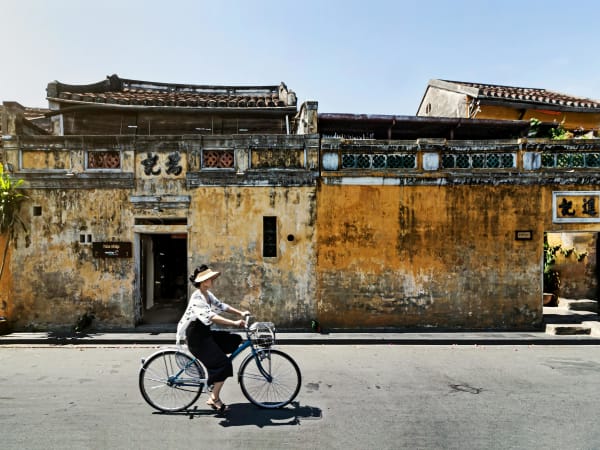
The Ancient Town is organised around Trần Phú Street - the main east-west axis - and the riverfront Bạch Đằng Street. The key heritage buildings include the Japanese Covered Bridge (Chùa Cầu) at the western end, the Tấn Ký Ancient House and Phùng Hưng House on Nguyễn Thái Học, the Phúc Kiến Assembly Hall on Trần Phú, and the central market near the river. The streets between are lined with yellow-walled shophouses selling silk, lanterns, tailored clothing, lacquerware, and art. The Thu Bồn riverfront has cafes and restaurants with views across to the coconut-palm-lined opposite bank. On the 14th of each lunar month (and every Saturday), Đêm Phố Cổ transforms the streets from 6 PM to 10 PM: all electric lights off, lanterns everywhere, traditional rowing boats on the river. It is one of the most atmospheric evenings in Vietnam.

🧳 Tips

Hội An rewards slow travel more than almost anywhere in Vietnam. One full day covers the landmarks; two or three days lets you find the less-visited streets, eat your way through the food stalls, cycle to Trà Quế village and An Bàng Beach, and experience the town at different times of day. The crowds are real - Trần Phú Street at 11 AM in peak season is shoulder-to-shoulder - but the town is large enough that early mornings (5-6 AM), late evenings (after 9 PM), and the quieter eastern streets remain genuinely pleasant.

Based on real traveler experiences and commonly mentioned advice from multiple visitors.

Come at 5-6 AM for the quietest photography conditions - empty alleys, locals going about their morning, no tourist crowds
For river boats: 150,000 VND for 3 people. Always confirm the boat is a traditional rowing boat (thuyền chèo) before boarding - motorised boats are not permitted in the Old Town area
Bargain for souvenirs and tailored goods - prices can drop significantly from initial quotes. For tailoring, order on day one to allow time for fittings and alterations.
For the quietest experience, come between 5-6 AM - the Old Town is almost empty, locals are doing their morning routines, and the streets feel like a completely different place. The best window for photography without tourists.
Explore again after 9 PM when the day-trippers from Đà Nẵng have left - the town is still atmospheric but noticeably calmer than peak evening hours
The 120,000 VND ticket covers 5 entries from a list of 22 heritage sites - choose the ones you want rather than rushing through all five
Đêm Phố Cổ (Lantern Night): on the 14th of each lunar month from 6 PM to 10 PM, the central Old Town cuts all electric lights and switches entirely to lantern light. 2026 dates: Feb 11, Mar 13, Apr 11, May 11, Jun 9, Jul 9, Aug 7, Sep 6, Oct 5, Nov 4, Dec 3. Also runs every Saturday and on major lunar festivals.
Boat on the Thu Bồn River: 150,000 VND for a 3-person boat (check before boarding - only traditional rowing boats are permitted in the Old Town area, not motorised boats. Confirm the boat type in advance to avoid being taken elsewhere.)
Floating lanterns (đèn hoa đăng) to release on the river cost 5,000-10,000 VND each - best on Lantern Night
Cao Lầu is the dish to eat in Hội An - the noodles are made with water from a specific ancient well and can't be authentically replicated anywhere else
The streets east of the central market (Trần Quý Cáp, Hoàng Diệu) are less visited than the Trần Phú main strip and have better preserved shophouse rows without the souvenir density
If ordering tailored clothing, place the order on the first morning to allow time for fitting and alterations - never order on the last day

Common questions from travelers who've visited this place.

When is the Lantern Night (Đêm Phố Cổ) and what happens?
Đêm Phố Cổ runs every 14th of the lunar month from 6 PM to 10 PM. The central Old Town cuts all electric lights and switches to lantern light only. 2026 dates: Feb 11, Mar 13, Apr 11, May 11, Jun 9, Jul 9, Aug 7, Sep 6, Oct 5, Nov 4, Dec 3. It also runs every Saturday. Floating lanterns (đèn hoa đăng) for the river cost 5,000-10,000 VND each.
When is the best time to visit Hội An?
For the quietest experience: 5-6 AM when the town is almost empty. For the most atmospheric: Lantern Night (14th lunar month, 6-10 PM). For good weather: February-April. Avoid mid-day peak hours in the main streets year-round.
Is tailoring in Hội An reliable?
Quality varies significantly between shops. Order early in your stay (first morning) to allow time for fitting and alterations before departure. Never order on the last day. Research and compare before committing - don't feel pressured to decide on the spot.
Explore more
hoi an - Full Guide
View destination guide →