Overview
Things to Know
Gallery



About This Place
What Makes La Vang Sanctuary Special
La Vang Sanctuary in Hải Lăng district, Quảng Trị province is Vietnam's national Marian centre and the most important Catholic pilgrimage site in the country, formally known as Vương Cung Thánh Đường Đức Mẹ La Vang. The surrounding area was once known as Dinh Cát, a broad sandy region dating to the era of Lord Nguyễn Hoàng in the 16th century. The tradition dates to 1798, when Vietnamese Catholics fleeing persecution under the Tây Sơn emperor Cảnh Thịnh (who reigned 1792-1801) took refuge in the remote forest here. According to the account passed down through generations, the community gathered nightly under a banyan tree to pray the rosary, and one night a beautiful woman appeared in traditional Vietnamese áo dài, holding the infant Jesus, accompanied by two angels. She told them to boil leaves from the surrounding trees as medicine and promised that those who came to pray here would receive her blessing - some accounts note the shrine site may have earlier held a small local folk shrine built by foresters, which was given over to the new Marian devotion. The name 'La Vang' itself has two competing explanations: it may derive from 'la lớn,' the loud shouting people used to communicate and call for help in the deep forest, or from 'lá vằng,' the medicinal leaf the apparition is said to have recommended.
A simple thatched chapel followed soon after 1798; a tile-roofed church was built in 1886 and formally inaugurated in 1901, coinciding with the first La Vang pilgrimage congress and its Marian procession - its interior followed traditional Vietnamese architectural style with seating for several hundred, while the facade was Western in style, flanked by two towers.
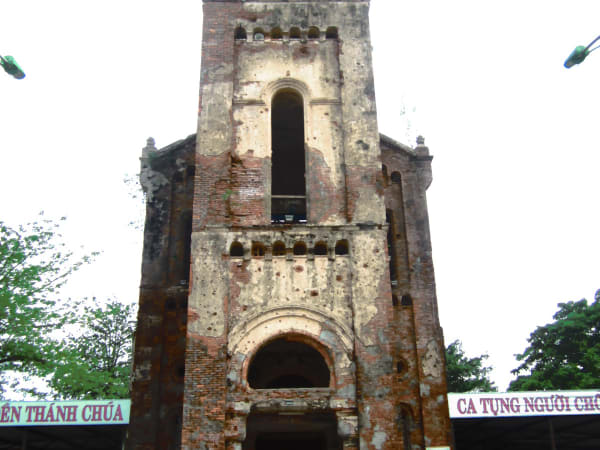
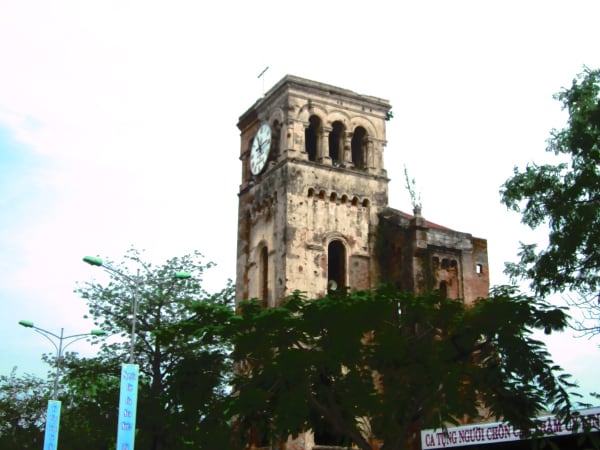
As that building became too small and worn, a larger church - two-tiered roof, twin transepts, and the now-iconic two-storey square bell tower - broke ground on 11 February 1924 (the Feast of Our Lady of Lourdes) under the direction of Father Morineau Trung, to a design by architect Carpentier; it was consecrated on 20 August 1928. Further work in 1955, 1961, and the years following added a plaza, a meditation pond, monastery buildings, 15 stone statues of saints, additional altars, and guesthouses for pilgrims. On 13 April 1961, the Bishops' Conference of South Vietnam, meeting in Đà Lạt under Archbishop Ngô Đình Thục, petitioned the Holy See to elevate the church to Minor Basilica status and formally declared La Vang Vietnam's National Marian Centre - a status the Vatican confirmed by decree the same year. The 1928 basilica was destroyed in the intense fighting around Quảng Trị during the summer of 1972 - only the bell tower survived, and it stands today as a deliberate, unrestored memorial.
How to Get There
Getting There
La Vang is 6km south of Quảng Trị town and 58-60km north of Huế city, directly off National Highway 1A. From Huế, take Highway 1A north past Đông Hà; at Hải Phú commune, follow signs for La Vang. From Đà Nẵng, it's roughly 160km, about 3 hours 15 minutes by road. By train, the nearest stations are Quảng Trị or Đông Hà, from which the sanctuary is reachable by taxi or motorbike. Many Huế-based tour operators include La Vang as part of a DMZ day trip alongside Vinh Mốc tunnels and Khe Sanh combat base, though the sanctuary is also an easy independent stop if you're driving between Huế and Quảng Trị.
What to Expect
On the Ground
Don't expect a single monumental cathedral - today's sanctuary is a collection of chapels, memorials, open squares, and the preserved bell tower spread across spacious grounds, rather than one grand building. The complex includes the ruined 1928 bell tower, the Apparition Shrine (three artificial banyan trees with the statue of Our Lady), the operating Chapel of Our Lady, the 2002 Eucharistic Chapel, a large pilgrimage square, and extensive grounds under ongoing development. The three-banyan-tree monument is the focal point for prayer and photography. The ruined bell tower - its crumbling brick walls left unrestored - carries enormous emotional weight as both a religious site and a record of the 1972 war. Most visits take 1-1.5 hours; the grounds are largely outdoors and exposed, so early morning or late afternoon is more comfortable than midday and tends to be quieter too. On ordinary days the site is calm; during the August 13-15 festival - sometimes called the 'Lourdes of Vietnam' by Catholic pilgrimage guides - it becomes one of the largest religious gatherings in Vietnam, with hundreds of priests concelebrating outdoor Mass, a large Marian procession, and many pilgrims sleeping on the grounds overnight. The crowd includes a notable number of overseas Vietnamese Catholics returning specifically for the festival from communities in the US, Australia, and France.
Travel Tips
Tips
La Vang fits naturally into a Quảng Trị and DMZ day itinerary from Huế - a full day covers La Vang, the Quảng Trị Citadel ruins (also heavily damaged in 1972), Vinh Mốc tunnels, and the Bến Hải River DMZ crossing. For non-Catholics, the historical layers here are as compelling as the religious ones: the 1798 persecution, the 1972 war, and the ongoing reconstruction give La Vang an unusually rich narrative for what first appears to be a straightforward church complex.
Insider Tips
Based on real traveler experiences and commonly mentioned advice from multiple visitors.
FAQ
Common questions from travelers who've visited this place.
Why is the church partially destroyed?›
What is the significance of La Vang?›
Is there information available in English?›
Nearby Locations
Explore more things to do like this around Vietnam