Overview
Things to Know
Gallery


About This Place
What Makes One Pillar Pagoda Special
The One Pillar Pagoda - Chùa Một Cột in Vietnamese, also historically known as Liên Hoa Đài ('Lotus Platform'), Chùa Mật, or Diên Hựu Tự - is a small Buddhist shrine rising from a square lotus pond in the Ba Đình district of Hanoi, recognised in 2012 by the Asia Records Organization as having the most unique architecture of any pagoda in Asia. According to legend, Emperor Lý Thái Tông ordered its construction in 1049 after dreaming of the bodhisattva Quan Âm seated on a lotus throne, who led him up to it; a monk advised him to build the pagoda in the shape of that lotus in gratitude, and it was named Diên Hựu ('lasting blessing'). The design - a shrine perched on a single pillar rising from a pond - evokes a lotus blossom emerging from water, the Buddhist symbol of enlightenment arising from the impurity of the world. It's worth knowing that what stands today is considerably smaller and simpler than the original: under Emperor Lý Nhân Tông in 1105, the complex was expanded with the Linh Chiểu lake, twin white ceramic-topped towers, a gilded lotus flower crowning the pillar, and a purple-lacquered inner shrine decorated with mythical bird carvings, and historical records describe the original shrine building as roughly 4.6m per side - noticeably larger than the current version's approximately 3m. The pagoda was destroyed by French forces in 1954 shortly before their withdrawal from Hanoi, and rebuilt in 1955 by architect Nguyễn Bá Lăng at a deliberately reduced scale, using more modern materials (including concrete in places) rather than a full reconstruction of the original Lý-dynasty complex - only the single-pillar shrine survives today, not the wider temple grounds it once had.
How to Get There
Getting There
The One Pillar Pagoda is located in the Ba Đình district of central Hanoi, immediately southwest of the Ho Chi Minh Mausoleum complex. From Hoàn Kiếm Lake, it is approximately 3km west - easily reached by taxi, Grab, or a 40-minute walk through the French Quarter and along Điện Biên Phủ street. City buses also pass near the Mausoleum complex for a budget option (around 7,000-9,000 VND) - check current routes and stops locally, since exact bus numbers have varied across sources. The nearest major landmarks for navigation are the Ho Chi Minh Mausoleum and Ba Đình Square. Many visitors combine the pagoda with the mausoleum in a single morning visit.
What to Expect
On the Ground
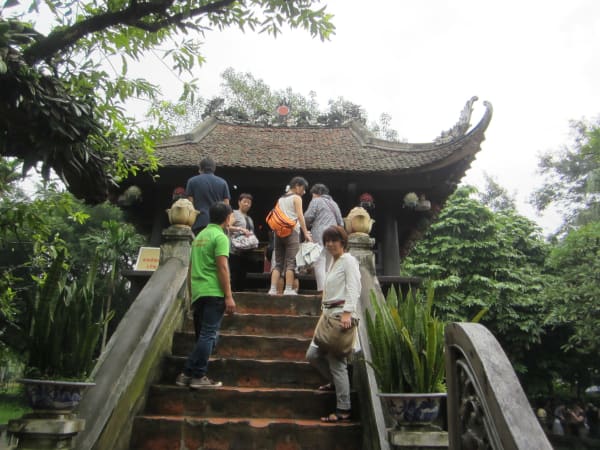
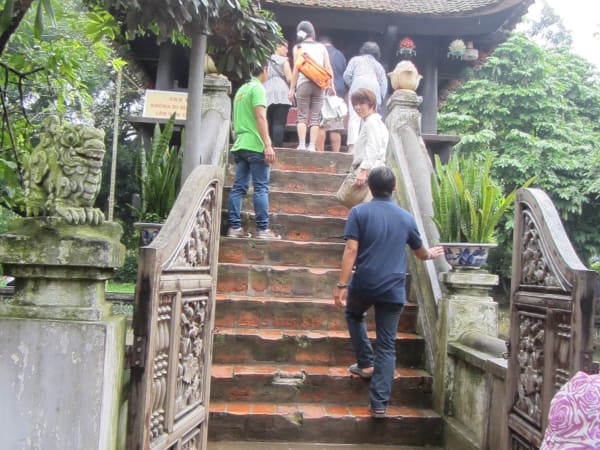
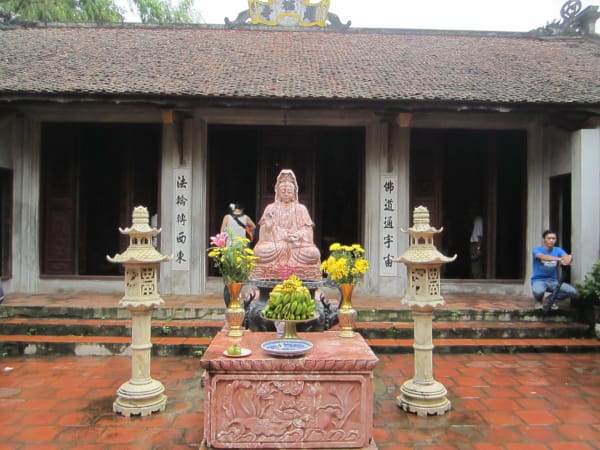
Visitors first pass through a two-tiered Tam Quan gate with three passageways (the wider central one is the main entrance), inscribed with the name Diên Hựu Tự. A 13-step staircase, about 1.4m wide, leads up to the Liên Hoa platform. The platform itself is a roughly 3-metre square with railings, resting on a pillar around 4m tall above the waterline (with more submerged) and about 1.2m in diameter, formed from two stacked sections. Inside sits a gilded thousand-armed, thousand-eyed Quan Âm statue, surrounded by incense burners, vases, and ceremonial items, with red-and-gold lacquered cloud motifs and a small horizontal board reading 'Liên Hoa đài.' The tiled roof, weathered and moss-covered with age, carries a 'lưỡng long chầu nguyệt' (two dragons flanking the moon) motif on its ridge, a common decorative theme in Vietnamese temple architecture symbolising yin-yang harmony. The 1st and 15th of each lunar month bring a formal cleaning and ceremony at the pagoda. The surrounding square pond and its lotus plants form the main visual element of the site, with a small courtyard of frangipani trees and stone inscriptions around it. The pagoda functions as an active shrine - incense burns at the altar and Vietnamese worshippers visit regularly. Expect a security checkpoint with a metal detector and bag check given the proximity to the Mausoleum complex. The pagoda itself is small enough to explore in around 30 minutes, though budgeting 2-3 hours makes sense if combining it with a proper visit to the wider Ba Đình / Mausoleum complex.
Travel Tips
Tips
The One Pillar Pagoda is a site where understanding its cultural significance rewards a longer pause than the structure's small scale might suggest. It represents an architectural tradition that has no direct equivalent elsewhere - the deliberate encoding of Buddhist cosmology into building form, in a structure that has been rebuilt and venerated continuously for nearly a thousand years despite war, occupation, and demolition. The pagoda is best visited in the morning when the light is favourable for photography and before the midday tour bus arrivals, and it's particularly atmospheric during Tết, when many locals come to pray for the new year. Manage your expectations on scale: the pagoda is genuinely small, and many Vietnamese visitors are surprised by this on their first visit too - there also isn't a great deal else in the immediate vicinity beyond the pond and courtyard, so 30 minutes is enough to see it properly. What makes it worth the stop is the architecture and history, not the size. A natural half-day pairing looks like this: park your bike or arrange transport to Ông Ích Khiêm/Ngọc Hà street, queue for the Ho Chi Minh Mausoleum early to beat the sun and crowds, visit Ho Chi Minh's Stilt House and the Presidential Palace grounds within the same complex, then walk over to the One Pillar Pagoda to light incense and stroll around the lotus pond, finishing at the adjacent Ho Chi Minh Museum (a striking, modern lotus-inspired building in its own right) next door. Interestingly, replicas of the One Pillar Pagoda have been built in other Vietnamese cities, including Ho Chi Minh City and Hải Phòng - a sign of how deeply the structure has become a national symbol rather than just a Hanoi landmark.
Insider Tips
Based on real traveler experiences and commonly mentioned advice from multiple visitors.
FAQ
Common questions from travelers who've visited this place.
What or who is worshipped at the pagoda?›
Is there an entrance fee?›
What is the dress code?›
How long does a visit take?›
Nearby Locations
Explore more things to do like this around Vietnam