Some experiences don't work just because you show up. They depend on too many things at once - and in Vietnam, people have a phrase for this kind of gamble: "test nhân phẩm", which loosely translates to a test of luck, timing, and cosmic favor.
To see bioluminescent plankton, you need:
The right place: sheltered water, minimal waves, no light pollution.
The right timing: clear skies, no rain - even if it rained earlier that evening, visibility drops significantly. A moonless or dim-moon night works best; too much moonlight washes out the blue glow.
Even with all of that in place, nothing is guaranteed. Imagine paying 900,000 VND, paddling a kayak at 8 PM in complete darkness, and seeing nothing but black water. That's the risk. That's why most people skip this tour.
This is not that kind of article that tells you it's magical and unforgettable and you absolutely must go. If you're the kind of traveler who seeks out unusual nighttime experiences and doesn't mind gambling a bit of money on something that might not work out - then read on.
Why You Can't See Bioluminescence Just Anywhere in Vietnam
Bioluminescent plankton are microscopic organisms that emit light when the water around them is disturbed. They exist in many parts of Vietnam's coastline - but most places don't have a high enough density to see clearly with the naked eye.
Two factors determine visibility: plankton density and surrounding darkness. The cleaner the water, the less light pollution, the denser the bloom - the brighter the blue.
In my experience, there are two places in Vietnam where it's genuinely worth trying: Lan Ha Bay in Cat Ba, and Ba Hon Dam near Phu Quoc in Kien Giang. I've been to both. They're completely different experiences.
Lan Ha Bay, Cat Ba - Bioluminescence Between Limestone Karsts
Why Most Vietnamese Travelers Skip This Tour
The guide told me I was the first Vietnamese person he'd ever seen join the kayaking tour. The other ten Vietnamese travelers that night had all chosen squid fishing instead.
A few reasons, I think:
For something this unusual, most people want reviews before committing. This tour has almost no Vietnamese reviews online - so by default, it reads as not worth doing.
Night kayaking is physically demanding compared to sitting on a boat fishing. And you can't photograph it - no good photos to post means less incentive to go.
Then there's the price. 900,000 VND for ninety minutes in the dark is steep by most people's standards.
The guide also explained why it costs more than other tours: this is a protected marine area. The permits required to operate here are complicated to obtain. Not every operator is allowed in - which is why the price is what it is.
How to Book
Buy directly at any hotel or hostel in Cat Ba town. It's usually listed as a "plankton tour."
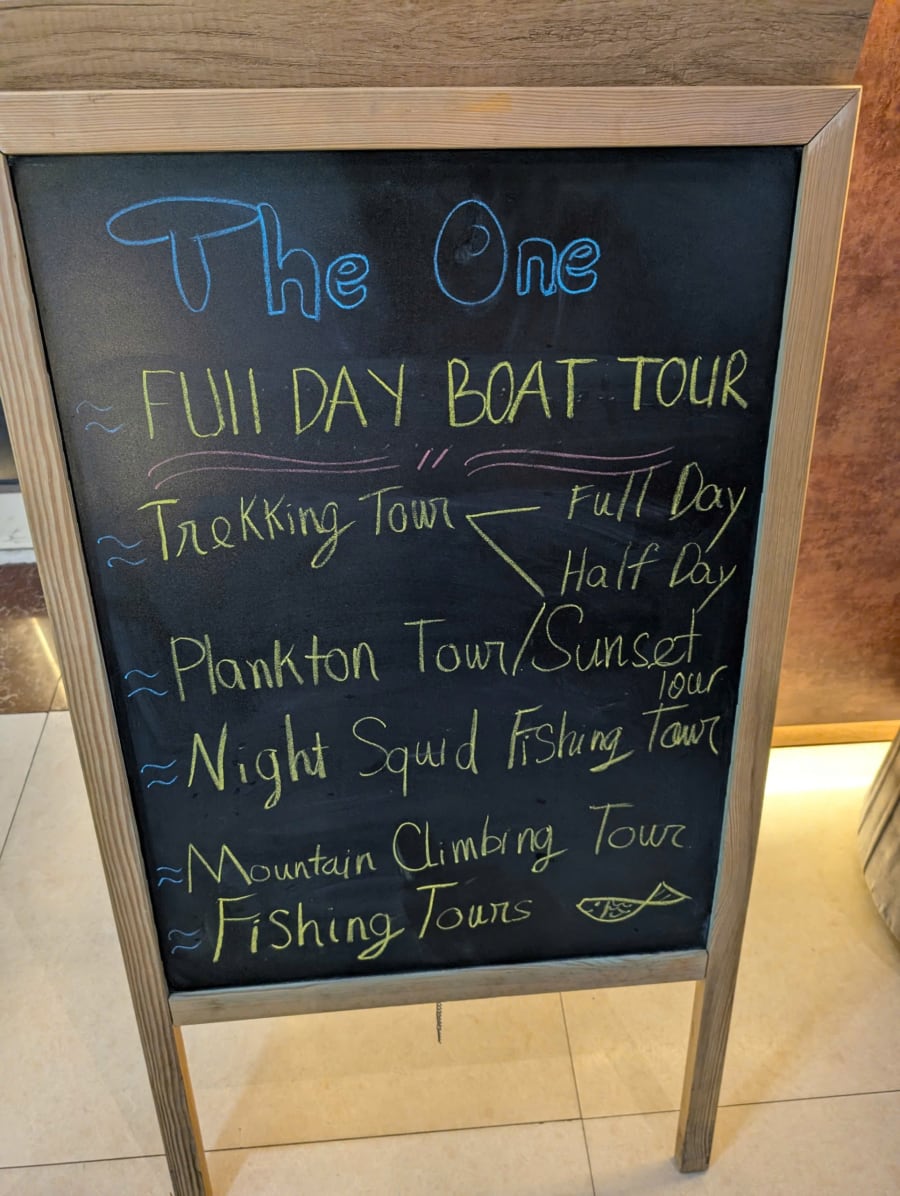
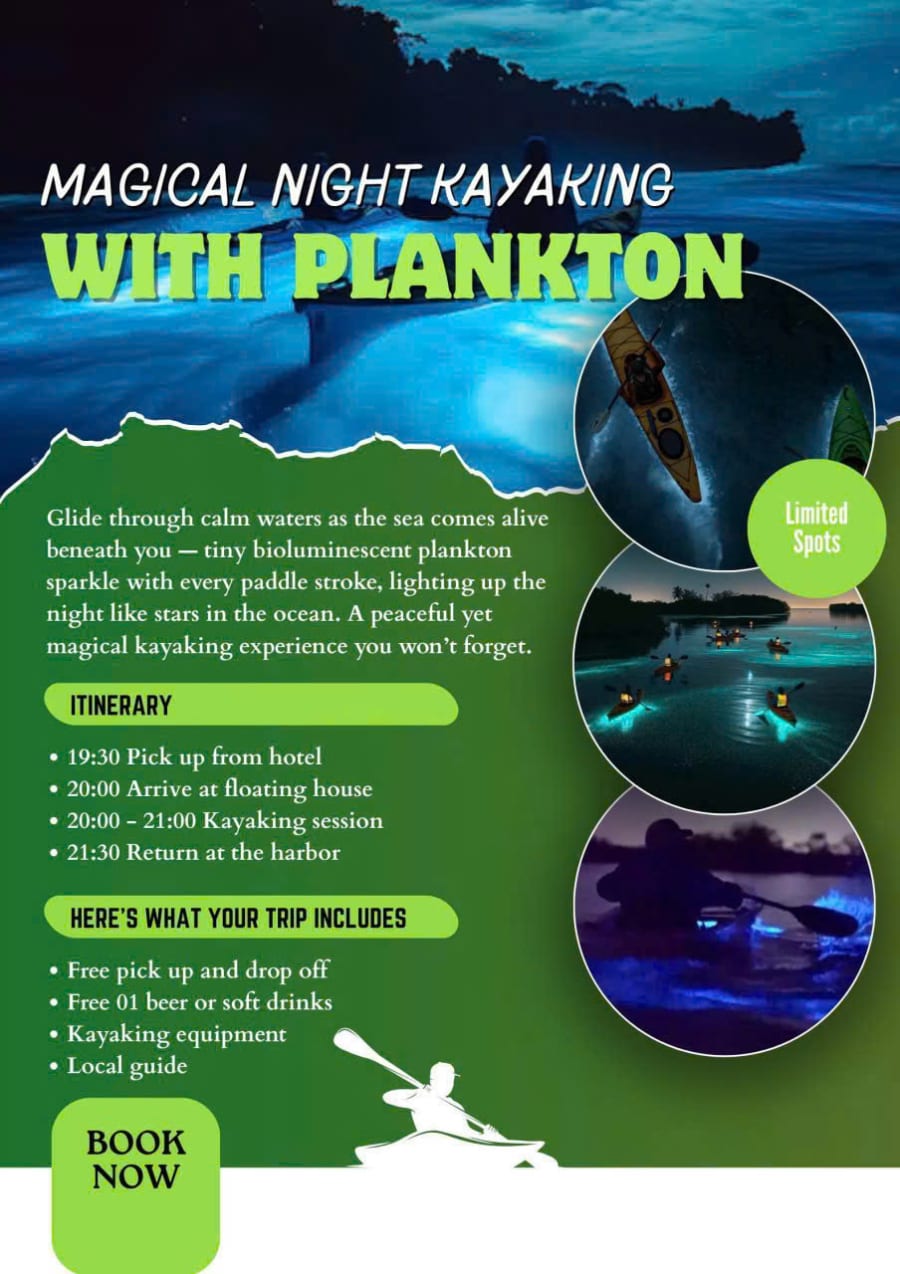
Note: prices vary by where you book. I paid 900,000 VND; a friend who booked through a different hostel paid 28 USD (~730,000 VND) - about 170,000 VND cheaper than me. Ask around before committing.
Basic Itinerary
- 7:30 PM - Hotel pickup
- 8:00 PM - Arrive at floating platform in the bay
- 8:00-9:00 PM - Night kayaking session
- 9:30 PM - Return to harbor
One thing to know: because this tour runs with small groups, it's usually combined with a squid fishing tour leaving from the same boat. Expect your schedule to shift depending on the fishing group. The night I went, we returned 30 minutes early because the squid fishers got seasick - more in the Cat Ba itinerary.
Choosing the Right Night
Don't go on a full moon night - too bright, the plankton glow gets drowned out. But don't go on a completely moonless night either - you won't be able to see the limestone karsts surrounding you.
A dim moon is ideal. If the bioluminescence doesn't show up clearly, at least the landscape is still worth paddling through. You won't walk away with nothing.
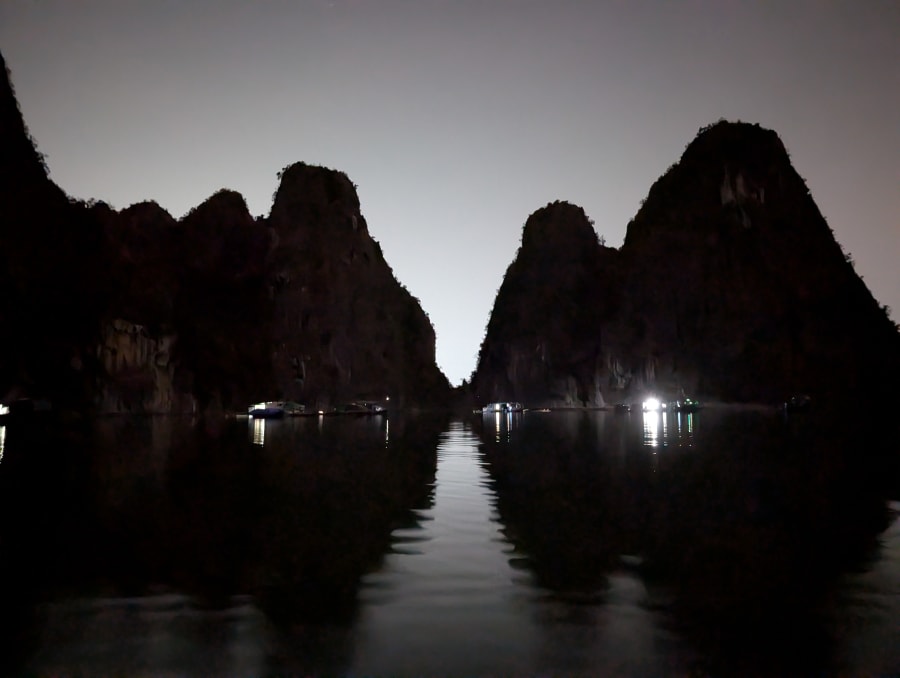
The Experience in Lan Ha Bay
Limestone walls rising straight up on both sides. Moonlight above. The only sounds: the dip of the paddle into water, the soft knock of waves against rock faces. Below - every stroke disturbed the surface and the bioluminescence lit up underneath, blue-green streaks flaring and fading with the current. Like a scene from Final Fantasy. Or something I don't actually have a reference for.
I tried to photograph it several times. Couldn't get it. Some of the best things I've seen while traveling were things I couldn't bring home. Maybe that's fine. Some experiences are better kept in memory than on a camera roll.
Paddle close to the limestone walls rather than open water - the plankton density is noticeably higher along the rock faces. Every stroke lights up more.
Ba Hon Dam, Kien Giang - A Different Kind of Bioluminescence
Getting There
Ba Hon Dam is a small island cluster near Phu Quoc in Kien Giang province. Take a boat out and stay overnight. For full logistics and other activities on the island, see the Ba Hon Dam location page.
Foreign visitors are welcome. That said, come prepared: nobody on the island speaks English, mobile internet is weak and unreliable, and you may need your passport for check-in at the accommodation. Download offline maps and anything else you need before you get on the boat.
There's no dedicated bioluminescence tour here. The plankton are simply part of what happens when you stay overnight - not something you book separately.
When to See It
Bioluminescence at Ba Hon Dam appears late - after 10 PM is when visibility is most reliable. Locals say it happens year-round, just stronger on some nights than others.
It shows up right at the beach next to the accommodation. No kayak needed, no boat, no guide - you just walk out and get in the water. Shallow enough to stand, chest-deep at most.
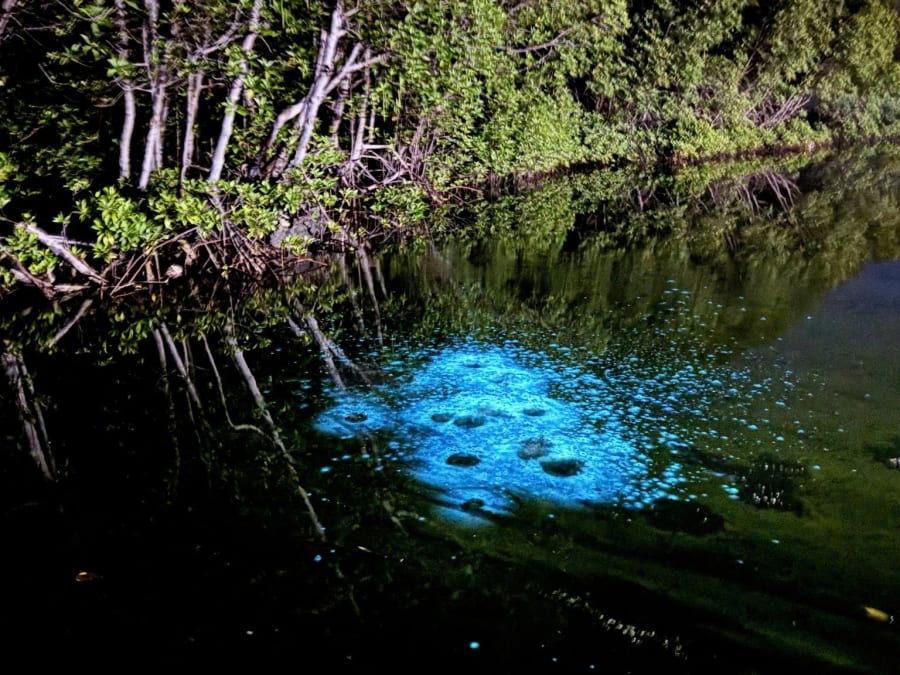
The Experience at Ba Hon Dam
That trip, I was with a group of friends. We'd rented a bungalow right on the water.
One of my friends, a few beers in, walked to the edge and peed into the sea.
Someone else looked over and shouted: "Hey. He's been eating the fish here and they're radioactive. His pee is glowing blue."
I looked. "No. That's not radioactive. That's bioluminescent plankton."
Without thinking, I jumped in - forgetting that thirty seconds earlier, my friend had been standing in the same spot.
I swam until midnight. When I finally got out, I dragged a mattress onto the porch and lay there facing the water. The surface kept lighting up in flickers of blue with every gust of wind, and would suddenly brighten when a fish moved underneath.
I wished someone would sit with me and watch it all night.
Lan Ha vs Ba Hon Dam: The Comparison
| Lan Ha Bay (Cat Ba) | Ba Hon Dam (Kien Giang) | |
|---|---|---|
| How you experience it | Guided night kayaking | Swimming freely |
| Dedicated tour | Yes (900,000 VND) | No |
| Best time to see | ~8:00-9:00 PM | After 10:00 PM |
| Surroundings | Limestone karsts, bay | Small beach, bungalows |
| Vibe | Cinematic, structured | Raw, unplanned |
| Foreign visitors | Easy | Welcome - no English spoken, weak internet |
| Cost | High (tour fee) | Included in overnight stay |
| Photography | Almost impossible | Almost impossible |
Which One Should You Go To
Traveling from Hanoi or northern Vietnam - Lan Ha Bay, Cat Ba. Closer, easier logistics, clear tour structure.
Traveling from the south or passing through Phu Quoc - Ba Hon Dam. Rawer experience, no tour groups, and almost no English-language coverage of this place exists.
Want something harder to forget - Ba Hon Dam. Not because it's more beautiful - but because it has no script.
Practical Notes
Best conditions for seeing bioluminescence:
- Dim moonlight - not too bright, not completely dark
- Clear skies, no rain - and no rain earlier that evening either
- Calm water
- Turn off all lights, including phone screens, when you're in the water
Do not attempt the night kayaking option alone or without a guide. The water is calm but visibility is near zero once you are away from the boat.
Nothing guarantees you'll see it even in ideal conditions - that's the cosmic gamble built into this experience.