Menu
DestinationsLocationsBlogMapAbout
📍 nature · attraction · cultural

An Nhứt Rice Fields

An Nhứt Rice Fields in Long Điền district, Bà Rịa - Vũng Tàu province, is a 2,000-hectare countryside escape near Vũng Tàu city - a 2km winding road through golden rice paddies, a lone tree landmark, drone photography spot, and a weekend countryside food market with bamboo stalls from 4 PM.

🌾 Rice Fields📷 Golden Season🍜 Countryside Food Market🌅 Sunset Views
🧭 Get Directions
Best Time to Visit
📅 Rice harvest seasons: late March to early April, and early August, when the fields turn golden. Weekend afternoons for the food market atmosphere.
Entry Fee
🎟️ Free
Opening Hours
🕐 Open all day. Food stalls and market vendors: approximately 4:00 PM - 10:00 PM on weekends, but vendors close earlier if it's quiet - in practice most stalls wind down by 8:30 PM.
Address
📌 Xã An Nhứt, Long Điền, Bà Rịa - Vũng Tàu
👥Crowds
Weekdays are quiet and almost empty. Weekends, particularly during harvest season, attract visitors from Vũng Tàu and HCMC.
🥾Difficulty
No difficulty - flat walking and cycling on asphalt roads throughout
⚠️Safety
The 2km road through the fields is narrow with no guardrails and no street lighting after dark, with deep irrigation canals alongside it in places - ride carefully, especially around blind curves and after sunset
🚶Accessibility
Flat and fully accessible - asphalt roads throughout, suitable for all mobility levels
🌤️Seasonal
Most photogenic during harvest seasons (late March-early April and early August) when fields turn golden. Green growing season is beautiful but different. Post-harvest (bare fields) is least rewarding. November visit: lush green fields noted as beautiful by visitors.

What Makes An Nhứt Rice Fields Special

Most visitors come to Vũng Tàu for the beaches. Few expect one of the province's most photogenic landscapes to be a sea of rice instead. Just 30 minutes from the coast, An Nhứt swaps waves for 2,000 hectares of paddies, a winding country road, and one of southern Vietnam's simplest yet most rewarding sunset photography spots.

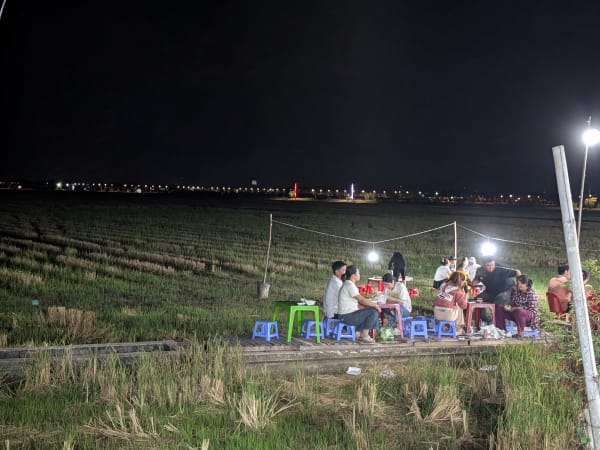
Before tourism reshaped Vũng Tàu's coastline, much of today's Bà Rịa province relied on rice farming and fishing. An Nhứt remains one of the few places where that older agricultural landscape survives at scale, largely unbothered by the resorts and seafood restaurants that now define the coast just half an hour away. A 2km winding asphalt road runs through the middle of the paddies like a ribbon through the landscape, flanked in some sections by trees with yellow blossoms. A lone tree standing in the centre of the fields became the signature landmark after the location went viral on social media in 2024 - unlike the famous solitary trees of New Zealand or Iceland, it carries no historical or symbolic weight of its own; it simply became an accidental icon after showing up repeatedly in Vietnamese photography and social feeds. The rice cycle follows traditional seasonal rhythms - the two harvest windows when the paddies turn gold are the most photogenic periods, but the deep green of the growing season and the white egrets that work the fields year-round give the location a different but equally valid beauty outside harvest time. Rather than a permanent market, a cluster of bamboo food stalls appears along the dike road every weekend, set up by local families as city visitors arrive for sunset.

🚗 Getting There

An Nhứt is located in Long Điền district, approximately 30km southwest of Vũng Tàu city centre, near National Highway 55. From Vũng Tàu, the drive takes approximately 30-40 minutes by motorbike or car. From Ho Chi Minh City, the journey takes approximately 1.5-2 hours by car via the expressway. Navigate by GPS to Xã An Nhứt, Long Điền - there is no entry signage from the main road so GPS is essential. The roads throughout the area are asphalt and easily accessible by both motorbike and car.

👀 On the Ground

The landscape is flat open paddies with the 2km winding road as the main attraction for photography. The lone tree in the fields is the signature shot. During harvest season (late March-early April and early August), the golden colour of ripe rice against the sky in the late afternoon light is the primary draw. Outside harvest season, the deep green of growing rice with egrets flying overhead has its own appeal. On weekends from 4 PM, food stalls built from bamboo and bamboo poles set up along the dike road with local countryside dishes - bánh khọt, bánh xèo, grilled corn, roasted bananas, boiled shellfish - at prices from 5,000-25,000 VND. The atmosphere is casual and local. Kite flying is a popular weekend activity among families. The fields can also be cycled through for a slower experience. Unlike the terraced rice fields of northern Vietnam, An Nhứt is about openness rather than elevation - wide skies, long horizons, and changing light define the experience more than dramatic topography, so it's worth adjusting expectations away from a Mù Cang Chải-style landscape. The road itself has no guardrails or streetlights, so it's best enjoyed in daylight rather than after dark.

🧳 Tips

An Nhứt works best as a late afternoon visit - arrive around 3:30-4 PM to walk the fields in comfortable temperature, catch the golden hour photography window between 4-5 PM, and stay for the food market which opens from 4 PM. Combine with Phước Hải beach for a full day trip from Vũng Tàu. If you're visiting Vũng Tàu for two days, this is one of the easiest ways to experience a completely different side of the province without driving far from the coast. Check the rice calendar before building a trip specifically around the golden harvest aesthetic - timing is everything and the window for golden rice is only a few weeks per harvest cycle.

Based on real traveler experiences and commonly mentioned advice from multiple visitors.

Arrive around 3:30-4 PM - comfortable temperature, golden photography light, and food stalls opening
Avoid shooting against the sun between 4-5 PM or faces will be dark - position yourself with the sun behind you
No public toilets on site - use facilities before arriving
⚠️ The 2km road through the fields is narrow, has no guardrails, and has no street lighting after dark - deep irrigation canals run alongside it in places. Take blind curves slowly, avoid sudden stops, and don't ride it after sunset unless you already know the road well
Best photography time is 4-5 PM when the light is golden and the heat has dropped - avoid shooting against the sun or faces will be dark
Avoid visiting at noon unless you're specifically coming for drone photography - there is very little shade across the open fields
The 2km winding asphalt road through the fields is the main scenic route - walk or cycle slowly along it rather than stopping only at the entrance
The 'lonely tree' (cây cô đơn) standing alone in the middle of the fields is the most photographed spot - best in golden hour light at sunset
Drone photography is highly recommended - the true scale of the fields only becomes apparent from above. Check local regulations before flying.
Time your visit carefully - the golden harvest season (late March-early April and early August) is when the fields are most photogenic. Green season is also beautiful but different in character. Post-harvest (fields cut bare) is the least rewarding time.
Weekdays are quiet and almost empty. The food market and most visitors arrive on weekend afternoons.
Food stalls open from 4 PM with local southern Vietnamese dishes - bánh khọt, bánh xèo, ốc luộc, chuối nướng, prices from 5,000-25,000 VND. Stalls are built from bamboo along the dike road through the fields.
Going as a group makes it easier to share and try more dishes at the food market
QR code payment accepted at most vendors
No public toilets on site - use facilities at Long Điền town or find a nearby cafe before arriving
No entry signage from the main road - navigation by GPS to Xã An Nhứt, Long Điền is the most reliable approach
Combine with Phước Hải beach (nearby) for a full day trip from Vũng Tàu - stop for bánh canh Phước Hải on the way

Common questions from travelers who've visited this place.

When is the best time to see the golden rice fields?
The two harvest seasons when the rice turns golden fall around late March-early April and early August, though exact timing shifts a little each year with planting schedules. A green season visit (other months) still offers scenic fields with egrets and a cooler, lush atmosphere - just a different aesthetic.
Is the food market open every day?
The food stalls are primarily a weekend operation - Saturday and Sunday from approximately 4 PM. Weekdays have minimal or no vendor activity. Vendors close earlier if it's quiet - most wind down by 8-8:30 PM.
Can I fly a drone here?
Drone photography is popular at An Nhứt and the aerial perspective significantly enhances the compositional possibilities. Check current Vietnamese civil aviation regulations and local restrictions before flying - no formal drone zone designation has been reported but regulations apply.
Do I need a drone to get good photos here?
No. A drone shows off the fields' full scale better than any ground-level shot, but the winding road and the lone tree both photograph well from the ground too - it's a nice-to-have, not a requirement.
Is it worth visiting outside harvest season?
Yes, though the experience is different. Outside the golden harvest windows, the fields are a deep green with egrets working the paddies - still scenic and much quieter, just without the golden-hour colour that harvest season is known for. Visiting right after harvest, when the fields are cut bare, is the one time that's genuinely less rewarding.
Can I cycle here?
Yes - the 2km asphalt road through the fields is flat and well-suited to cycling, and it's a slower, quieter way to see the paddies than driving straight through.

Explore more things to do like this around Vietnam