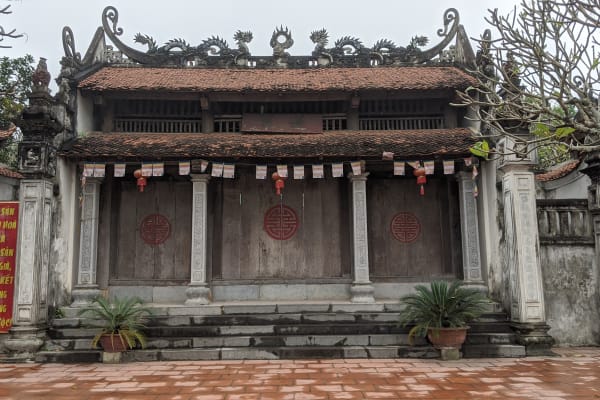
Dâu Pagoda - also known as Diên Ứng, Pháp Vân or Cổ Châu Pagoda - is considered the oldest pagoda in Vietnam and the cradle of Vietnamese Buddhism. It stands in the old Luy Lâu area, the earliest centre of Buddhism in the country, where the religion arrived along trade routes from India and China. According to historical records, it was built between 187 and 226 AD, during Chinese rule. It is a special national relic, and its popular name comes from the mulberry (dâu) trees grown in the area for silkworms.
Under Chinese rule, Dâu Pagoda was a place where monks such as Khâu Đà La (Kalacarya), Mâu Tử and Vinitaruci practised and taught. Under the Lý and Trần dynasties, when Buddhism flourished, the court restored it; in 1072 and again in 1703 its Pháp Vân statue was carried to the capital to pray for the rain to stop. In 1313, under Emperor Trần Anh Tông, the scholar Mạc Đĩnh Chi led a major restoration, remembered in the saying 'a nine-storey tower, a nine-span bridge, a pagoda of a hundred rooms'. Today's buildings reflect many later restorations.
The Legend of Man Nương and the Four Dharmas
According to legend, a young woman named Man Nương became pregnant through the blessing of the Indian monk Khâu Đà La. Her daughter was placed inside a sacred mulberry tree; after a great storm the tree floated to Luy Lâu and was carved into four statues - the Tứ Pháp, or Four Dharmas: Pháp Vân (Cloud), Pháp Vũ (Rain), Pháp Lôi (Thunder) and Pháp Điện (Lightning). A glowing stone linked to the legend, the Thạch Quang Buddha, is still worshipped at the pagoda.
Dâu Pagoda is the head of the four Tứ Pháp pagodas and honours Pháp Vân, the goddess of clouds. The others are Đậu (Thành Đạo) Pagoda for Pháp Vũ, Tướng (Phi Tướng) Pagoda for Pháp Lôi and Dàn (Phương Quan) Pagoda for Pháp Điện, all near the old Luy Lâu citadel. This blend of Buddhism with the rice farmers' worship of natural forces is what gives Dâu its unique character: people come not only to pray for peace and good health, but also for good weather and good harvests.