Overview
Things to Know
Gallery




About This Place
What Makes Don Village Special
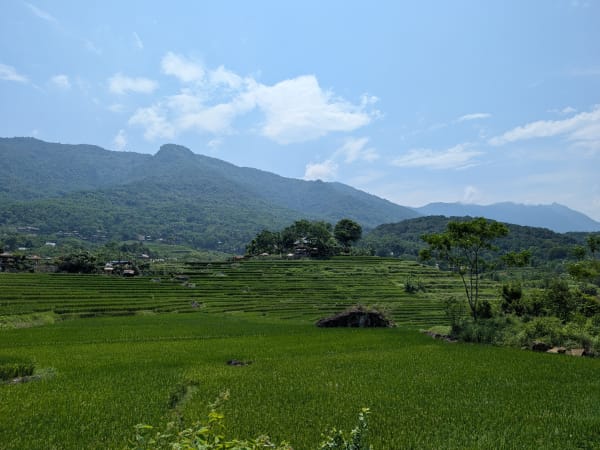
Don Village (Bản Đôn) is the most established and most photographed village inside Pù Luông Nature Reserve in Bá Thước District, Thanh Hóa Province, home to just over 80 households and roughly 285 people, mostly ethnic Thai with a smaller Mường population - of these, around 23 households (plus one larger community-tourism business) are involved in hosting visitors. The village sits on a sloping hillside above a wide bowl of stepped rice terraces, with traditional Thai stilt houses arranged along the contour, traditional wooden water wheels (cọn nước) turning by the streams, and a small road descending into the valley floor. Over the past decade Don Village has become the de facto base for visitors to Pù Luông, with the largest concentration of homestays, eco-lodges, and small retreats in the reserve. Despite the development, the village retains a working agricultural character - families still farm the terraces, water buffalo work the paddies, and daily life proceeds at the pace of the rice cycle. Beyond the scenery, cultural activities on offer around the village include Thai xòe dance performances, cần rice wine shared from communal jars, campfire evenings, and brocade weaving demonstrations. The defining image of Don Village is the rice bowl itself: in late May it is luminous green, in late September it turns gold for harvest, and outside these windows it sits in shades of brown and pale yellow under a backdrop of forested limestone ridges.
How to Get There
Getting There
Don Village is approximately 170km southwest of Hanoi and around 130km from Thanh Hóa city. The most common access is by private car or motorbike from Hanoi via the QL6 highway through Hòa Bình, then south through Mai Châu and into Bá Thước - a 4 to 5 hour drive. An alternative route follows the Hồ Chí Minh Road, then QL217 to Cành Nàng town, over La Hán bridge, and onto QL15C into Don Village - this road has sections with tight curves, narrow mountainside stretches, and grades of up to 25% in places, so drive with care, especially on a motorbike. Limousine services from Hanoi run for around 300,000 VND per person. Flying into Thọ Xuân airport (Thanh Hóa's own airport) rather than Nội Bài can also work, followed by a private transfer of around 1.5 hours. Direct sleeper buses run from Mỹ Đình bus station in Hanoi to Phố Đoàn, the small market town near Pù Luông, from where a xe ôm or pre-arranged homestay pickup covers the final 8km to Don Village. Most travellers reach Don Village as part of a 2 to 3 day Pù Luông itinerary rather than a day trip.
What to Expect
On the Ground
Days in Don Village are slow by design. Mornings are spent walking or cycling through the terraces below the village, watching mist clear off the valley floor and farmers move between paddies. The viewpoint above the village is a short uphill walk from the main road and is the standard sunrise spot. Most homestays serve Thai-style family meals - sticky rice, grilled river fish, bamboo-cooked vegetables, and rice wine - and many offer guided treks to neighbouring villages such as Hieu Village, Kho Muong Village, and Bản Nủa. The middle of the day tends to be hot and bright; activity resumes in the late afternoon when the light softens for photography. Evenings are quiet, with limited nightlife by design.
Travel Tips
Tips
Don Village rewards a 2-night stay rather than a flying visit - one full day is needed to walk down into the terraces, visit a neighbouring village, and catch both sunrise and sunset light. The village is the easiest entry point to Pù Luông for first-time visitors, with the most homestay options across budgets, but it is also the most developed and the most visited. Travellers seeking a quieter, less photographed experience should pair Don Village with a night in Kho Muong Village or Hieu Village for contrast. Outside the rice harvest weeks, Don Village is significantly less crowded and homestays are easier to book on short notice.
Insider Tips
Based on real traveler experiences and commonly mentioned advice from multiple visitors.
FAQ
Common questions from travelers who've visited this place.
How many nights should I spend in Don Village?›
When are the rice terraces at their best?›
Is Don Village good for a day trip from Hanoi?›
Nearby Locations
Explore more things to do like this around Vietnam