Menu
DestinationsLocationsBlogMapAbout
📍 cultural · hue

Khải Định Tomb

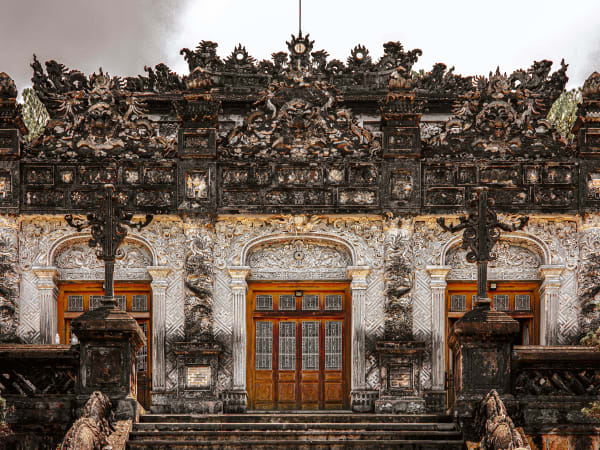
Khải Định Tomb (Ứng Lăng) is the most visually striking of Huế's royal mausoleums - a dark concrete palace fusing Vietnamese, French, Gothic, Roman, and Hindu architectural styles, covered inside with intricate porcelain and glass mosaics. Smallest in footprint but most costly and time-consuming to build of all Nguyễn tombs.

👑 Nguyễn Tomb🏯 French-Vietnamese Architecture📸 Photography✨ Mosaic Interior
🧭 Get Directions
Best Time to Visit
📅 Jan - Feb (most comfortable weather in Huế - ideal). Feb - Apr and Sep - Nov also good (dry season, best light for photography).
Entry Fee
🎟️ Adults 150,000 VND / Children (7-12) 30,000 VND
Opening Hours
🕐 Summer (16 Mar - 15 Oct): 6:30 AM - 6:00 PM. Winter (16 Oct - 15 Mar): 7:00 AM - 5:30 PM. Arrive at least 30-45 minutes before closing for a full visit.
Address
📌 Châu Chữ, Hương Thủy, Thừa Thiên Huế
👥Crowds
Busiest around 3 PM. Quieter in the morning or just after lunch. Popular check-in/photography spot, so expect some photo-taking crowds regardless of time.
🥾Difficulty
127 steep steps total - take care on the descent. Challenging for visitors with mobility issues or knee/hip problems. Little shade on the outer grounds.
⚠️Safety
Watch your footing on the steep steps. No flash photography inside Cung Thiên Định. Dress modestly and keep noise down - a solemn, sacred site.
🚶Accessibility
150,000 VND adult / 30,000 VND child (7-12). Hats must be removed when entering the building. Combo tickets with other Huế sites offer better value than single entries.
🌤️Seasonal
Jan-Feb: most comfortable weather - ideal. Feb-Apr & Sep-Nov: also good, dry season, best photography light. Hours shift seasonally: summer (16 Mar-15 Oct) 6:30 AM-6 PM, winter (16 Oct-15 Mar) 7 AM-5:30 PM.

What Makes Khải Định Tomb Special

Khải Định Tomb - also known as Ứng Lăng - was built by Khải Định, the 12th Nguyễn emperor, who ruled from 1916 to 1925 under French protectorate conditions that left him with largely ceremonial power. He personally selected the site on Châu Chữ hillside and directed construction beginning 4 September 1920. He died in 1925 and was buried inside while work continued; the tomb wasn't completed until 1931, under his successor Bảo Đại - 11 years in total, the longest construction time, highest cost, and most modern design of any Nguyễn royal tomb, despite having the smallest footprint (117m × 48.5m). Lê Văn Bá led the construction, working with renowned craftsmen from across the country. To help fund it, Khải Định requested a 30% increase in land tax from the French protectorate government - a decision that drew fierce criticism from contemporaries and remains historically controversial, seen by critics as a symbol of collaboration with French rule. Materials were imported internationally: steel, cement, and slate tiles from France, porcelain and coloured glass from China and Japan. The result is a fusion unlike any other Nguyễn tomb - traditional Vietnamese elements combined with French Gothic, Roman, and Hindu architectural influences, set on a forested hillside that gives it the appearance of a European castle transplanted into the Vietnamese countryside. The grey concrete exterior often surprises first-time visitors, making the explosion of colour inside even more dramatic. Inside, the Cung Thiên Định (Thiên Định Palace) holds the most elaborate interior of any Vietnamese royal tomb - every surface covered in mosaic assembled from fragments of porcelain, glass, and ceramic, forming dragons, phoenixes, clouds, and celestial scenes. A bronze effigy of the emperor sits above the actual burial vault beneath the Cửu Long (nine dragons) canopy.

🚗 Getting There

Khải Định Tomb is on Châu Chữ hillside, about 10km south of central Huế. By motorbike or taxi: Highway 49, about 20-30 minutes. By bus: route 05 (Bến xe Đông Ba - Chợ Tuần) passes near the tomb - catch it at Đông Ba bus station on Trần Hưng Đạo street if you're north of the river, or flag it down along central south-bank roads like Điện Biên Phủ, Lê Ngô Cát, or Minh Mạng street if you're staying on that side. Frequency is low (45-60 minutes between buses) and timing isn't always reliable, so most independent travellers - especially those visiting multiple tombs in one day - rent a motorbike (100,000-150,000 VND/day) instead. Most travellers combine Khải Định with Tự Đức Tomb (nearby) and sometimes Minh Mạng Tomb in a single royal tombs circuit by motorbike, all within about a 15km radius of central Huế.

👀 On the Ground

The tomb rises in terraces up the hillside via 127 steps divided into platforms, each flanked by stone mandarins, elephants, and horses standing at attention - steep in sections, so take it slowly, especially in heat. The Cung Thiên Định at the summit is the visual centrepiece: a single large chamber where floor, walls, and ceiling are entirely covered in mosaic made from broken porcelain and coloured glass imported from China, France, and Japan. The detail rewards close inspection - patterns shift from geometric to figurative to calligraphic across the surfaces. It's dark inside, so adjust your camera settings accordingly (no flash permitted). The bronze statue of Khải Định sits on a dais above the sealed burial vault beneath the Cửu Long canopy. The surrounding hillside has gardens and smaller pavilions, though the outer grounds offer little shade - bring sun protection.

🧳 Tips

Of Huế's seven royal tombs, Khải Định is the most visually dramatic and the most compact - a good choice if you only have time for one. Tự Đức Tomb is the natural pairing: larger, more garden-oriented, and more traditionally Vietnamese in feel, an easy combination in the same afternoon since they're close by. Minh Mạng Tomb is the most architecturally grand of the three but takes more time to explore properly. For first-time visitors to Huế with one day, the standard itinerary - Imperial City in the morning, Thiên Mụ Pagoda midday, Khải Định Tomb in the afternoon - covers the three most visually distinctive sites in the city. Go early if possible; the sun gets intense by midday with little shade on the grounds.

Based on real traveler experiences and commonly mentioned advice from multiple visitors.

Go early morning or just after lunch to avoid the 3 PM crowd peak and midday heat
Bring a hat or umbrella - little shade on the outer grounds
Adjust camera settings for low light inside Cung Thiên Định; no flash allowed
Combine with Tự Đức Tomb (nearby) or Minh Mạng Tomb for a fuller royal tombs day
Consider áo dài or Vietnamese traditional dress - this is one of Huế's most photogenic check-in spots
Also called Ứng Lăng. Smallest in footprint of all the Nguyễn royal tombs (117m × 48.5m), but took the longest to build, cost the most, and is considered the most modern in design.
Construction began 4 September 1920 under Khải Định's direct supervision - he personally chose the site and directed the build. He died in 1925 and was buried inside while construction continued; the tomb wasn't finished until 1931, under his successor Bảo Đại. Total: 11 years.
Lê Văn Bá (Tiền quân Đô thống phủ) led construction, with renowned craftsmen from across Vietnam including Phan Văn Tánh, Nguyễn Văn Khả, Ký Duyệt, and Cửu Sừng.
Funding came partly from a controversial 30% land tax increase Khải Định requested from the French protectorate government - a decision that drew strong criticism at the time and remains a point of historical debate. Materials were imported: steel, cement, and slate roof tiles from France; porcelain and coloured glass from China and Japan for the mosaic work.
127 steps total from the gate to the main tomb area, steep in sections - take it slowly, especially in midday heat, and watch your footing on the descent.
The interior mosaic work in the Cung Thiên Định (Thiên Định Palace) chamber is the highlight - spend time on the ceiling and upper walls, not just the emperor's effigy. This is widely considered the most elaborate interior of any Vietnamese royal tomb.
Go in the morning - the tomb faces a direction where the facade light is best before noon, and mornings are cooler and less crowded than the 3 PM peak.
The grounds outside have little shade and get very sunny - bring a hat or umbrella.
Dress modestly - áo dài or Vietnamese traditional dress is a popular and fitting choice here, and the tomb is one of Huế's most photogenic check-in spots. Research good photo angles beforehand if that's a priority.
Adjust your camera settings for low light inside the Cung Thiên Định - it's quite dark inside, and no flash photography is allowed.
Reading a little about Khải Định's life and reign beforehand adds context to both the architecture and the controversy surrounding the tomb.
Keep your voice down and move respectfully - this is a solemn, sacred site.
Compact site - the full visit takes 45-60 minutes to 1-2 hours depending on pace, making it easy to combine with Tự Đức Tomb or Minh Mạng Tomb (both nearby) in the same day. Going early in the day helps avoid both crowds and heat.
Nearby combinations: Minh Mạng Tomb, Thiệu Trị Tomb, and Thiên An Monastery are all within reach for a fuller day.
From central Huế: motorbike or taxi via Highway 49 (about 20-30 minutes). Bus option: route 05 (Bến xe Đông Ba - Chợ Tuần) - catch it at Đông Ba bus station on Trần Hưng Đạo if you're on the north bank, or flag it down along central south-bank roads like Điện Biên Phủ, Lê Ngô Cát, or Minh Mạng if you're staying in that area. Frequency is low (45-60 minutes between buses) and timing can be inconsistent, so motorbike rental (100,000-150,000 VND/day) is the more reliable option, especially if combining Khải Định with Minh Mạng and Tự Đức tombs in one day.

Common questions from travelers who've visited this place.

Is Khải Định Tomb worth visiting?
Yes - for most visitors it's the standout among Huế's royal tombs precisely because it looks so different from the rest. The grey concrete exterior often surprises first-time visitors, making the explosion of colour inside Cung Thiên Định even more dramatic when you reach it. It's also the most time-efficient tomb to visit (45-60 minutes), making it easy to pair with another tomb in the same day. If you only have time for one royal tomb in Huế and want the most visually striking, unconventional choice, Khải Định is it. If you'd rather prioritise a more traditional, garden-oriented Nguyễn aesthetic, see the comparison questions below.
Khải Định Tomb vs Minh Mạng Tomb - which should I visit?
They represent opposite design philosophies. Minh Mạng impresses through near-perfect classical symmetry and harmony with nature - a still lake in front, a mountain behind, greenery on both sides, built at the height of Nguyễn imperial power. Khải Định impresses through deliberate unconventionality - a fusion of Vietnamese, French Gothic, Roman, and Hindu styles built under colonial-era constraints, with a stark exterior that gives way to an explosively decorated interior. If you want the architecturally 'correct' and serene experience, choose Minh Mạng. If you want the most visually surprising and photogenic experience, choose Khải Định. Many visitors do both in the same day since they're within easy motorbike range of each other.
Khải Định Tomb vs Tự Đức Tomb - which should I visit?
Tự Đức impresses with atmosphere - pine forest, a lake pavilion, and a sense of lived-in poetic melancholy, reflecting an emperor who used the site as a retreat during his lifetime. Khải Định impresses with architecture - ornate, dramatic, and unlike anything else in Huế, reflecting an emperor with a singular, controversial aesthetic vision. Visitors who want a contemplative, nature-immersed experience tend to prefer Tự Đức; visitors who want a striking 'wow' architectural moment tend to prefer Khải Định. The two are close enough together that combining them in one afternoon is the standard and recommended approach rather than choosing only one.
What makes Khải Định Tomb different from the other Nguyễn royal tombs?
It stands apart in almost every way. Architecturally, it's the only tomb that fuses traditional Vietnamese style with French Gothic, Roman, and Hindu influences - the result looks like a European castle on a Vietnamese hillside rather than a classical Nguyễn mausoleum. It has the smallest footprint of any tomb (117m × 48.5m) yet took the longest to build (11 years), cost the most, and used internationally imported materials (French cement and steel, Chinese and Japanese porcelain and glass). Its interior - the mosaic-covered Cung Thiên Định - is considered the most elaborate of any Vietnamese royal tomb. It's also the only tomb whose construction is tied to a specific historical controversy: a 30% land tax increase Khải Định requested from the French to help fund it, which drew criticism then and remains a debated chapter of his legacy now.
How long does it take to visit Khải Định Tomb?
About 45-60 minutes without a guide, up to 1-2 hours with a guide or audioguide for full historical context. It's the most compact of the major Huế tombs, which makes it easy to pair with Tự Đức Tomb or Minh Mạng Tomb in the same day.
How many steps are there and how difficult is the climb?
127 steps total from the entrance gate to the main tomb platform, divided across several terraces. The steps are steep in places - take care, especially on the way down, and allow extra time if travelling with anyone who has mobility or joint issues. There's little shade along the way, so morning visits are notably more comfortable than midday.
What is inside the tomb that visitors shouldn't miss?
The Cung Thiên Định at the summit is the must-see: a single chamber with floor, walls, and ceiling entirely covered in mosaic made from broken porcelain and coloured glass, forming dragons, phoenixes, and celestial patterns. A bronze statue of Khải Định sits above the sealed burial vault beneath the Cửu Long (nine dragons) canopy. The detail rewards slowing down - look at the upper walls and ceiling, not just the effigy at eye level.

Explore more things to do like this around Vietnam

Explore more
hue - Full Guide
View destination guide →