Menu
DestinationsLocationsBlogMapAbout
📍 landmark · heritage · cultural · ho chi minh city

Notre-Dame Cathedral Saigon

Saigon's Notre-Dame Cathedral is a French colonial landmark built entirely from materials imported from France between 1877 and 1880. Although the interior has been closed for restoration since 2017, the cathedral remains one of Ho Chi Minh City's most iconic landmarks and a favourite local gathering place.

⛪ French Colonial Icon🏛️ 19th Century📷 District 1 Landmark🧱 Red Brick Facade
🧭 Get Directions
Best Time to Visit
📅 Nov - Apr (dry season; exterior is photogenic year-round but rain makes the square uncomfortable). December for Christmas lights and decorations.
Entry Fee
🎟️ Free (exterior only; interior closed for restoration since 1 July 2017)
Opening Hours
🕐 5:00 AM - 8:00 PM daily. Best: early morning (5-8 AM) or late afternoon (4-6 PM) for cooler weather, better light, and fewer crowds.
Address
📌 01 Công xã Paris, Bến Nghé, Quận 1, Thành phố Hồ Chí Minh
👥Crowds
Busy throughout the day and into the evening; the square rarely feels empty. Early morning (5-8 AM) and late afternoon (4-6 PM) are calmer and have better light. December is the busiest period for Christmas decorations and photos.
⚠️Safety
Dress modestly if attending mass or planning to enter when access is available. Standard city awareness around the busy square (bags, belongings).
🚶Accessibility
Free exterior access at all times. Interior closed to general visitors since 2017 due to restoration. Mass continues on schedule for parishioners and visitors who wish to attend.
🌤️Seasonal
Nov-Apr: dry season, most comfortable for spending time in the square. Dec: Christmas lights and decorations make this one of the city's top check-in spots. Rainy season (May-Oct) makes the open square less pleasant to linger in.

What Makes Notre-Dame Cathedral Saigon Special

Notre-Dame Cathedral Saigon - formally the Vương Cung Thánh Đường Chính Tòa Đức Mẹ Vô Nhiễm Nguyên Tội (Basilica of Our Lady of The Immaculate Conception) - stands at the junction of Đồng Khởi and Nguyễn Du streets in central District 1. It was actually the second Catholic church the French built in this area: the first was a converted Vietnamese pagoda, repurposed during early colonial occupation, which quickly proved too small for the growing congregation. Construction of the current cathedral began 7 October 1877 under Bishop Isidore Colombert, using materials shipped entirely from France - red bricks from Marseille, stained glass from Chartres. The main building was completed in 1880; the twin bell towers, designed by architect Gardes, weren't added until 1895, bringing the structure to its current 57-metre height. The cathedral remains an active Catholic parish and one of Vietnam's largest religious structures, though the interior has been closed to casual sightseeing since 1 July 2017 for a major restoration using materials imported from Europe to match the original construction - a project that has run well past its original end-2027 target due to the extent of damage requiring careful, slower repair work. Regular mass continues throughout, and visitors are welcome to attend as respectful observers, but there is currently no general walk-in access to view the interior outside of service times. What keeps the surrounding square genuinely alive day to day, though, has less to do with religion than with local youth culture: 'cà phê bệt' on the grass facing the façade, pigeon feeding, street food, and the classic cathedral photo have made this one of Ho Chi Minh City's most reliable casual meetup spots for young Saigonese.

🚗 Getting There

The cathedral is located in the heart of District 1, at the top of Đồng Khởi street approximately 1km from Bến Thành Market. From most District 1 hotels, it is within walking distance. From Tân Sơn Nhất Airport: taxi or ride-hailing app, 20-30 minutes depending on traffic. From other districts: bus, metro (where operational), or taxi/ride-hailing to Công Xã Paris square. The cathedral is a natural stop on any walking tour of the French colonial architecture cluster in District 1, alongside the Central Post Office and Independence Palace.

👀 On the Ground

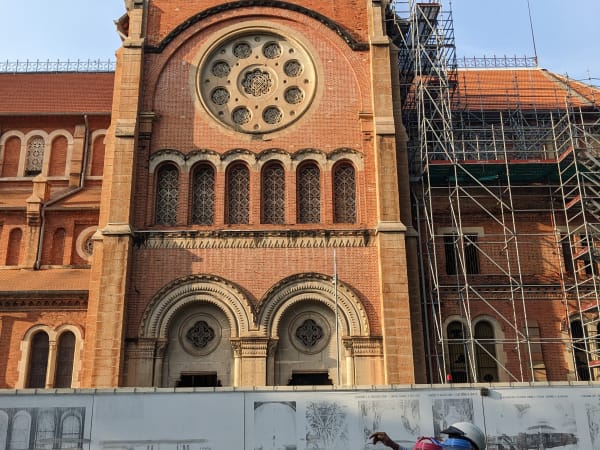
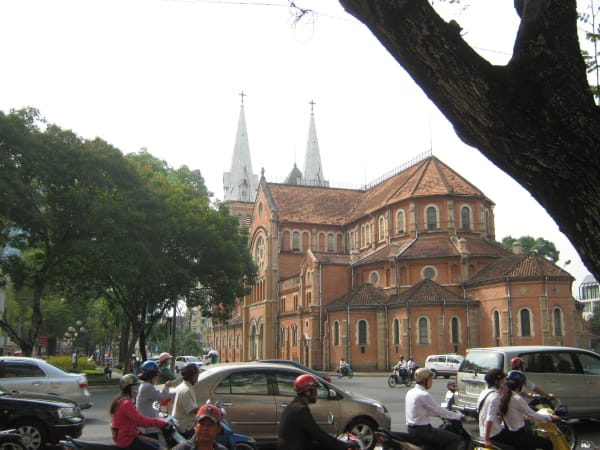
The visit centres on the exterior - the red brick neo-Romanesque/Gothic facade with its twin 57m towers, and the open square in front, are the main visual elements. The square contains a statue of the Virgin Mary that has drawn reported apparition claims and a steady stream of Catholic pilgrims alongside general tourists and local youth. Restoration work is visible but ongoing - sections of the original red brick façade have recently re-emerged from scaffolding as the project progresses, though full completion remains some years off. Inside, when accessible, the nave runs 93m long beneath a vaulted ceiling nearly 21m high, seating over 1,200 people, with marble altars and 56 Chartres stained glass windows depicting biblical scenes - but there is currently no general walk-in access to see this. The distinction matters: you cannot enter simply to look around, but you can enter to attend a scheduled mass as a respectful observer, which is the only way to see the interior at present. The Central Post Office immediately adjacent - designed by Gustave Eiffel's firm and still fully operational - is worth entering instead; its iron-frame interior is one of the finest colonial-era interior spaces in Vietnam. Around the square, expect pigeons, coffee vendors, street food carts, and a steady stream of people taking the same iconic facade photo from slightly different angles.

🧳 Tips

The cathedral works on two registers at once: a serious piece of French colonial architecture and religious history, and a low-key, much-loved local hangout spot. Don't expect to go inside during your visit - the restoration has been running since 2017 and is now expected to extend well past its original 2027 target - but the exterior alone, combined with the Post Office next door, makes for a solid 45-minute stop. If attending mass interests you (even as a respectful non-Catholic observer), the Sunday 9:30 AM English-language service is the most accessible option for international visitors; just don't receive Communion and dress modestly. For the most local experience, skip the formal sightseeing approach entirely and just grab a coffee, sit on the grass facing the façade, and watch the city move around the square for twenty minutes - that's genuinely what most young Saigonese come here to do.

Based on real traveler experiences and commonly mentioned advice from multiple visitors.

Don't expect interior access - restoration has been ongoing since 2017 and is now expected to run past 2027
Combine with the adjacent Central Post Office (Eiffel-firm interior, still operational) for a fuller 45-minute visit
Early morning or late afternoon for the best light and fewest crowds
Try 'cà phê bệt' on the grass facing the cathedral - the genuinely local way to spend time here
Sunday 9:30 AM English-language mass is the most accessible service for international visitors who want to attend respectfully
Official name: Vương Cung Thánh Đường Chính Tòa Đức Mẹ Vô Nhiễm Nguyên Tội (Basilica of Our Lady of The Immaculate Conception) - one of the largest religious structures in Vietnam.
This was actually the second Catholic church built by the French in this area. The first, smaller one was a converted Vietnamese pagoda on what's now Ngô Đức Kế street, repurposed by missionary Lefebvre after locals fled wartime occupation. It quickly proved too small, leading to construction of this cathedral.
Construction began 7 October 1877 under Bishop Isidore Colombert, combining Romanesque and Gothic styles. The twin bell towers weren't added until 1895 - 15 years after the main building was finished - designed by architect Gardes, reaching 57m total height (21m of which is the dome section).
Interior dimensions: 93m long, 35m wide, vaulted ceiling nearly 21m high, capacity over 1,200 people. Features a central nave, two side naves, and a row of side chapels. Altars are carved from solid marble; 56 stained glass windows (originally imported from Chartres, France) depict biblical scenes and figures.
The cathedral interior has been closed since 1 July 2017 for major structural restoration - every material (cement, sand, stone, brick) is being imported from Europe to match the original construction. Originally targeted for completion by end of 2027, but the parish priest leading restoration has stated this deadline won't be met due to extensive damage requiring more careful, slower work to ensure long-term durability. Visitors can still view and photograph the exterior throughout - after nearly a decade behind scaffolding and protective netting, sections of the iconic red brick façade have recently been revealed as restoration progresses.
If interior access matters to you, check current restoration status before visiting - the building remains an active parish and mass continues during restoration, just with limited visitor access to the nave.
Mass schedule: Monday-Saturday 5:30 AM and 5:30 PM (some sources also note a Thursday/Friday 8:00 PM mass). Sunday: 5:30 AM, 6:45 AM, 8:00 AM, 9:30 AM (English-language mass), 4:00 PM, 5:30 PM/5:15 PM, and an evening mass around 6:30-7:00 PM - times have varied slightly across sources and periods, so confirm locally if attending a specific mass matters to you.
Non-Catholics are welcome to attend mass as observers - just don't receive Holy Communion. Dress respectfully and modestly if planning to go inside for a service.
What actually draws young Vietnamese here isn't the building's interior - it's the surrounding square and street life. Popular activities: 'cà phê bệt' (sitting on the grass/curb with takeaway coffee facing the cathedral), feeding the resident pigeons, grazing on street food vendors around the square, and the classic full-facade or side-angle photo of the cathedral itself. It's a well-known casual meetup spot for local youth, not just a tourist stop.
The square in front of the cathedral and the adjacent Central Post Office (also French colonial, still operational, interior designed by Gustave Eiffel's firm) make a natural combined visit of around 30-45 minutes - the Post Office interior is genuinely worth entering.
Early morning offers the best photography light on the red brick facade and significantly fewer people in the square. December turns the area into one of the city's most popular Christmas-lights check-in spots.
Nearby combination: Independence Palace and the Central Post Office are both within easy walking distance for a fuller colonial-era Saigon walking tour.
From Tân Sơn Nhất Airport: taxi or ride-hailing app, 20-30 minutes depending on traffic. From central District 1: walkable, or by bicycle/cyclo to combine with nearby sights. From other districts: bus, metro (where lines are operational), taxi, or ride-hailing to Công Xã Paris square. Parking available nearby for motorbikes/cars at modest rates.

Common questions from travelers who've visited this place.

Why is it called Notre-Dame Cathedral?
'Notre-Dame' is French for 'Our Lady', referring to the Virgin Mary - the cathedral's formal dedication is to Our Lady of The Immaculate Conception. The name follows the same naming convention as Paris's famous Notre-Dame de Paris and many other Catholic cathedrals worldwide dedicated to Mary under this title. It's not a reference to the Paris cathedral specifically, just a shared naming tradition rooted in Catholic devotion to the Virgin Mary.
Can I go inside Notre-Dame Cathedral Saigon?
Not for casual sightseeing - the interior has been closed to walk-in visitors since 1 July 2017 for a major structural restoration using materials imported from Europe to match the original construction. The project was originally targeted for completion by end of 2027, but the parish's restoration lead has said this won't be met due to the extent of damage found, requiring slower and more careful repair work. However, regular mass continues throughout, and non-Catholic visitors are welcome to attend respectfully as observers (without receiving Communion) - this is currently the only way to see the interior. There's an important distinction here: you can't enter just to look around, but you can enter to attend a scheduled service.
What is the official name of the cathedral and why was it built?
Its formal name is Vương Cung Thánh Đường Chính Tòa Đức Mẹ Vô Nhiễm Nguyên Tội - the Basilica of Our Lady of The Immaculate Conception. It was actually Saigon's second French Catholic church; the first was a converted Vietnamese pagoda on what's now Ngô Đức Kế street, repurposed by missionary Lefebvre, which quickly became too small for the growing Catholic population. Construction of the current cathedral began 7 October 1877 under Bishop Isidore Colombert, with the main structure completed in 1880 and the twin bell towers added in 1895.
Why is the cathedral square popular with young Vietnamese people?
Mostly for reasons that have little to do with religion or architecture. 'Cà phê bệt' - sitting on the grass or curb with a takeaway coffee facing the façade - feeding the resident pigeons, grazing on street food carts around the square, and the classic cathedral photo have made this one of Ho Chi Minh City's most reliable casual meetup spots for local youth. The building itself draws history-minded tourists, but the square draws everyone else.
What are the mass times at Notre-Dame Cathedral Saigon?
Monday-Saturday: typically 5:30 AM and 5:30 PM. Sunday: multiple services including 5:30 AM, 6:45 AM, 8:00 AM, 9:30 AM (English-language mass), and several afternoon/evening services. Exact Sunday evening times have varied slightly across periods, so confirm locally if a specific service matters to your plans. Non-Catholics are welcome to attend as respectful observers.
Explore more
ho chi minh city - Full Guide
View destination guide →