Menu
DestinationsLocationsBlogMapAbout
📍 cultural · town · ha giang loop

Đồng Văn Old Town

Đồng Văn Old Town - 40 preserved stone houses at the core of the UNESCO Global Geopark, on Vietnam's northernmost plateau at 1,600m. Sunday minority market at dawn, weekly Saturday-Sunday cultural nights with bonfires and dancing, and a climate that occasionally brings frost and snow in winter.

🏘️ 40 Ancient Stone Houses🔥 Weekend Bonfire & Cultural Night🛒 Sunday Minority Market🌙 Night Market
🧭 Get Directions
Best Time to Visit
📅 Sep - Nov (buckwheat flowers, cooler air) or Mar - Apr (peach blossoms). Weekends for the cultural night events.
Entry Fee
🎟️ Free
Opening Hours
🕐 Open 24/7. Cultural night events: Saturday and Sunday evenings from around 8 PM.
Address
📌 Phố Cổ Đồng Văn, Đồng Văn, Hà Giang
👥Crowds
Weekdays: quiet, atmospheric. Friday to Sunday: significantly busier with Vietnamese domestic tourists, ethnic minority visitors, and foreign loop riders. Weekend cultural nights draw large crowds from 8 PM.
⚠️Safety
Bring cash from Hà Giang city - ATMs in Đồng Văn are unreliable. Cold year-round at 1,600m elevation - jacket required even in summer.
🚶Accessibility
Stone-paved lanes throughout the old quarter. Uneven surfaces in places.
🌤️Seasonal
Sep-Nov: buckwheat flowers, clearest skies - best overall. Feb-Mar: peach and apricot blossoms on the mountain slopes. Jun-Aug: cool but rainy season with storms. Dec-Feb: coldest months, temperature can drop below 10°C, frost (sương muối) common, occasional snow. Annual average 20°C but swings from 1-2°C at coldest to near 40°C at hottest. Always bring a jacket regardless of season.

What Makes Đồng Văn Old Town Special

Đồng Văn Old Town sits at 1,600m on the Đồng Văn Karst Plateau, 20km from the Chinese border. The name comes from the Mandarin 'tổng puôn' - meaning field of trade - reflecting its origin as a trading post in the early 20th century where merchants from China, Vietnam, and the local ethnic minority communities met to do business. The historic quarter has about 40 surviving stone houses built in rammed-earth wall construction, with yin-yang tile roofs, wooden doors, and stone-paved courtyards - dark grey, thick-walled, built to handle the plateau's bitter winters. Coffee shops, handicraft stalls, and lantern-lit shopfronts line the alleys. The surrounding landscape of jagged limestone karst makes it one of the most dramatic town settings in Vietnam. On weekends, the old town becomes a gathering point that transcends the usual boundaries of a tourist town - Vietnamese travellers, H'Mông and Lô Lô communities from surrounding villages, and foreign loop riders all converge around the weekly cultural nights, where bonfires and dancing start around 8 PM.

🚗 Getting There

Đồng Văn is 150km north of Hà Giang city - about 4.5 to 5 hours by motorbike along the Ha Giang Loop via Quản Bạ, Yên Minh, and Mèo Vạc passes. The road is well-paved but demanding, with steep switchbacks and sheer drops. Buses run from Hà Giang city daily but are slow and infrequent. Most travellers do the loop on a motorbike hired in Hà Giang city (150,000-200,000 VND/day for a semi-auto). Bring enough cash - ATMs in Đồng Văn are unreliable.

👀 On the Ground

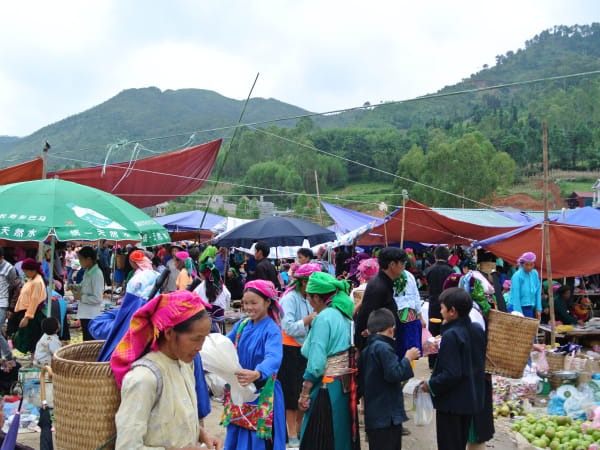
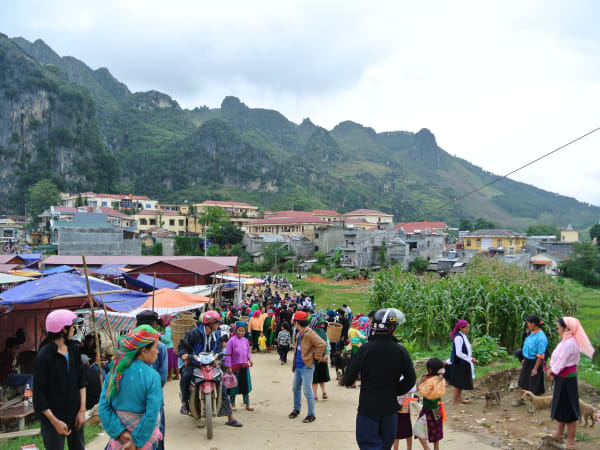
The old quarter covers a few blocks of stone-paved lanes lined with restored merchant houses, small guesthouses, coffee shops, and local restaurants. Lanterns hang along the alleys at night. The architecture is a genuine mix: H'Mông rammed-earth houses with walls 30-40cm thick (earth, straw, and organic materials) that insulate against the plateau cold, alongside French colonial structures with stone walls, high windows, and iron balconies. The Nhà Gác Đồng Văn (French watchtower/flagpost building) is the most prominent colonial remnant - solid stone, visually distinct from the earth-wall houses around it. The evening food scene centres on the main square - thắng cố, bánh cuốn Đồng Văn, and corn wine from stalls. On Saturday and Sunday evenings from around 8 PM, the night market area hosts the weekly cultural event: bonfires, music, dancing, and a mixing of communities that visitors describe as unexpectedly moving. Weekday mornings are the quietest - the stone alleys before 7 AM feel genuinely old. The Sunday dawn market is the place to see actual trade between Kinh, Tày, Nùng, and Lô Lô communities.

🧳 Tips

Accommodation ranges from homestays (400,000-1,000,000 VND/room or 100,000-250,000 VND/dorm bed) to guesthouses and hotels. Well-known options include Hagiang Holic, Plum Homestay, Đồng Văn Cliffside House, Đồng Văn H'Mông Homestay, and Khói Home - most are in the town centre or surrounding communes. Đồng Văn rewards staying 1-2 nights rather than passing through. The old town has two distinct versions depending on when you're there: weekday mornings (quiet, atmospheric, close to the original character of the place) and weekend evenings (lively, social, cross-cultural in a way that's become famous on Vietnamese social media). Neither is more valid than the other - they're genuinely different experiences. From Đồng Văn you can day-trip to Mã Pí Lèng Pass (20km), Lũng Cú Flag Tower (24km), and the Séo Lủng H'Mông village market. The Sunday morning market starts at dawn and winds down by mid-morning.

Based on real traveler experiences and commonly mentioned advice from multiple visitors.

Arrive Sunday morning at dawn for the minority market - it winds down by mid-morning
Saturday and Sunday evenings from 8 PM for the cultural night events at the night market - bonfires, music, and dancing
Weekday mornings before 7 AM for the quietest, most atmospheric version of the old town
Friday to Sunday evenings are the liveliest - the weekly cultural night at the old town night market brings Vietnamese visitors, ethnic minority communities, and foreign travellers together around bonfires, music, and dancing from around 8 PM. The atmosphere is genuinely warm and cross-cultural in a way that's hard to find elsewhere on the loop.
If you want quiet and authentic Đồng Văn - weekday mornings are when the old town feels like itself. The stone alleys, coffee shops, and lantern-lit shopfronts before 7 AM are a different place from the weekend crowds.
The Sunday morning market is for actual trade between Kinh, Tày, Nùng, and Lô Lô communities - not a tourist market. Arrive at dawn, it winds down by mid-morning.
The weekend cultural night events are viral on Vietnamese social media - they're worth knowing about, but also worth knowing that some visitors find them more commercial than culturally authentic. Both things are true: it's manufactured atmosphere, and it genuinely connects people across language and cultural barriers.
Đồng Văn means 'field of trade' - phonetically adapted from the Mandarin 'tổng puôn'. The town formed as a trading post in the early 20th century; the current old quarter has about 40 surviving stone houses built in rammed-earth wall construction with yin-yang tile roofs, wooden doors, and stone-paved courtyards.
It is cold year-round at 1,600m. Bring a jacket even in summer - nights on the plateau are genuinely cold regardless of season.
Bring enough cash from Hà Giang city - ATMs in Đồng Văn are unreliable.
The periodic market (chợ phiên) follows the lunar calendar on days 1, 6, 11, 16, 21, and 26 - different from the regular Sunday market. Check which falls during your visit if you want to catch it.
Best photography windows: 6-9 AM (before crowds, good light) or 3-5 PM (afternoon light on the stone facades).
The cafe-phien (phiên chợ-style coffee shops) along the old quarter are worth sitting in - slow coffee, stone walls, and the quiet rhythm of the street. A good counterpoint to the busy weekend evenings.
Corn wine (rượu ngô) from the old quarter stalls is the real thing. Stronger than it looks.

Common questions from travelers who've visited this place.

What are the Saturday and Sunday evening cultural nights?
Weekly events at the Đồng Văn old town night market, starting around 8 PM. Bonfires, live music, and dancing that brings together Vietnamese visitors, local ethnic minority communities, and foreign travellers. Viral on Vietnamese social media. Some visitors find them more commercial than authentically traditional - but they genuinely create a cross-cultural atmosphere that's unusual anywhere on the loop.
What is the Sunday morning market?
A trading market at dawn where Kinh, Tày, Nùng, Lô Lô, and H'Mông communities from surrounding villages gather to buy and sell. It's a working market, not a tourist market. Arrive early - it winds down by mid-morning.
How do I get to Đồng Văn from Hà Giang?
150km by the Ha Giang Loop - about 4.5 to 5 hours by motorbike via Quản Bạ, Yên Minh, and the major passes. Buses run daily from Hà Giang city but are slow. Most travellers hire a motorbike in Hà Giang city (150,000-200,000 VND/day). Bring sufficient cash - ATMs in Đồng Văn are unreliable.
Explore more
ha giang loop - Full Guide
View destination guide →