Menu
DestinationsLocationsBlogMapAbout
nature · river · ha giang loop

Nho Quế River

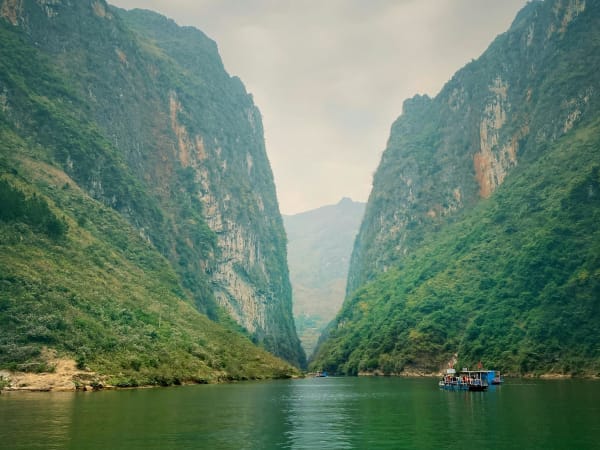
Nho Quế River - a ribbon of impossible turquoise threading through Tu Sản Canyon, one of the deepest and most dramatic gorges in Southeast Asia - seen from above at Mã Pí Lèng Pass and explored by boat from one of two piers near Đồng Văn and Mèo Vạc.

Turquoise RiverCanyonBoat TourPhotography
Get Directions
Best Time to Visit
Sep-Nov (autumn) is generally considered the best window - the water is at its clearest, most vivid turquoise, skies are clear, and it coincides with buckwheat flower season. Winter (Dec-Feb) still has clear water and a misty, atmospheric quality, but is genuinely cold - pack warm layers. Spring (Mar-Apr) brings peach and plum blossoms, though occasional light rain can make the water slightly murky. Summer (May-Aug) is best avoided if possible - frequent sudden rain tends to make the river run faster and murkier, undercutting the main reason to visit
Entry Fee
Pricing varies by pier, boat type, and operator, so treat these as a general guide rather than fixed: motorised boats with seating run roughly 100,000-150,000 VND/person (cheaper with a larger group or booking the whole boat), self-paddled wood or iron boats similarly around 100,000-150,000 VND/person (a rower available for hire if needed), and kayaks from around 50,000 VND/person - the cheapest option. Some operators instead price per boat rather than per person: small boats (2-4 people) around 400,000-500,000 VND for 45-60 minutes, larger boats (10-15 people, with a guide) around 800,000-1,000,000 VND for 60-90 minutes. A shuttle fee (around 50,000 VND one-way) may apply separately at some access points. One 2026 notice cites an all-inclusive 150,000 VND/adult rate (80,000 VND under 1.2m) covering shuttle and insurance, effective 13 April 2026 - confirm current pricing and what's included at the pier
Opening Hours
Roughly 7:00 AM – 6:30 PM; aim to arrive by 4:00 PM at the latest to leave enough time before dark, especially given the ride back over Mã Pí Lèng
Address
Nho Quế River, Mèo Vạc, Hà Giang
Crowds
Very popular with Vietnamese visitors who photograph at specific spots; fewer foreign tourists
Difficulty
The descent roads to both piers are steep and sharply curved, demanding confident motorbike handling; some access points also involve a walk of a kilometre or more from parking to the boat
Safety
The Mã Pí Lèng road connecting Đồng Văn and Mèo Vạc is dangerous to ride after dark, with sharp curves and steep drop-offs - plan your overnight base so you're not crossing it in fading light
Accessibility
Reachable by motorbike (own or hired xe ôm) to either pier; some walking may be required at the final stretch down to the water, which can be slippery when wet

What Makes Nho Quế River Special

The Nho Quế River runs 192km in total (about 46km within Vietnam), originating in China's Nghiễm Sơn mountains and entering Vietnam near Lũng Cú before carving through the limestone walls of the Đồng Văn Karst Plateau in shades of turquoise that seem almost artificially vivid in good light. Its most dramatic stretch is Tu Sản Canyon (Hẻm Tu Sản) - cliff walls rising 700-800m on either side over a length of roughly 1.7km, regarded as the deepest canyon in Southeast Asia - running alongside Mã Pí Lèng Pass. The river itself used to be considerably more dangerous, with fast rapids and small waterfalls; the construction of hydroelectric dams upstream calmed the water considerably, which is largely what made boat and kayak tourism here possible in the first place. From the Mã Pí Lèng viewpoint 1,500m above, the river looks like a thread of blue-green silk. From the water, the canyon walls rise hundreds of metres on both sides and the scale becomes genuinely overwhelming.

Getting There

The river has two main access piers, reached from different directions. Bến Tà Làng: from Đồng Văn, ride about 4km to 'ngã 3 đồi thông' (Pine Hill junction), turn left onto a concrete road toward Tà Làng, then continue until a signposted turn leads down to the pier - a steep, sharply curved descent where cars typically park near 'cầu Tràng Hương' bridge and hire a local driver for the final stretch (around 150,000 VND round trip); walking instead takes about 2km. Bến Xín Cái: continue past Đồng Văn along Mã Pí Lèng toward Mèo Vạc, and near the base of the pass look for a signposted left turn into Xín Cái commune - about 5km further to a drop-off point, then a roughly 2km walk down to where the boats moor. Guesthouses in either Đồng Văn or Mèo Vạc can arrange boat tickets and, in some cases, transport. Most Hà Giang Loop riders cross Mã Pí Lèng and treat the boat tour as a natural stop along the way, whichever pier fits their direction of travel.

On the Ground

The boat tour covers a section of the canyon, typically taking 1–1.5 hours return depending on the pier and boat type. The boats are small motorised wooden vessels holding around 4–6 people, and self-paddled boats or kayaks are also available. The canyon narrows dramatically in places, with sheer walls rising on both sides. The water color shifts from pale green in the shallows to a deep jade in the deeper sections. Swallows nest in the cliff walls and the sound of the motor echoes off the limestone. It's one of the most striking boat journeys in Vietnam.

Tips

The Nho Quế boat tour is best done after crossing Mã Pí Lèng, whichever direction you're travelling - this gives you both the aerial view from the pass and the ground-level perspective from the water in one day. Decide on your overnight base according to your route and timing rather than a fixed rule: Đồng Văn if you've used Tà Làng pier and are finishing later in the day, or Mèo Vạc if you're continuing on past Xín Cái pier. Either town offers a calmer, more genuine atmosphere than rushing the ride in fading light, which is worth avoiding given the pass's sharp curves and drop-offs.

Based on real traveler experiences and commonly mentioned advice from multiple visitors.

Confirm which pier your route/booking uses (Tà Làng or Xín Cái) before you set off, since they're reached from opposite directions
Book through your guesthouse or a booking app for convenience; group bookings often bring the per-person boat price down
Plan your day so you're not crossing Mã Pí Lèng after dark - finish the boat tour with enough daylight left to reach your overnight base safely
There are two separate boat piers, reached from different directions, so it's worth knowing which one fits your route: Bến Tà Làng is reached via Mã Pí Lèng from the Đồng Văn side (through Pải Lủng commune), while Bến Xín Cái is reached from the far end of the Mã Pí Lèng pass, closer to Mèo Vạc
⚠️ When navigating, search for 'Du lịch Hẻm Tu Sản' rather than a generic 'Sông Nho Quế' or 'Bến thuyền hẻm Tu Sản' - multiple visitors report the latter search terms leading to the wrong road entirely
A former popular photo spot known as 'Mỏm đá tử thần' (Death Rock outcrop) has reportedly been restricted or barriered off by local authorities due to safety concerns - don't be surprised if it's no longer accessible the way older photos suggest
Whether to base yourself in Đồng Văn or Mèo Vạc genuinely depends on which pier you use and what time you finish: if you're using Tà Làng pier and finishing in the late afternoon, staying in Đồng Văn saves you from re-crossing Mã Pí Lèng in fading light; if you're continuing on toward Mèo Vạc after Xín Cái pier, carrying on to Mèo Vạc for the night makes more sense than backtracking
The boat rides go into Tu Sản Canyon (Hẻm Tu Sản), regarded as one of the most spectacular gorges in Vietnam - the water color is most vivid on sunny mornings, while overcast days make it look grey
The canyon is best seen from two angles: from above at Mã Pí Lèng Pass and from the water on the boat tour
If you're visiting during the flowering season, keep an eye out for red silk cotton (gạo) trees blooming along parts of the riverbank - a striking seasonal bonus
On the boat, wear the life jacket provided for the full ride, follow the crew's instructions, and avoid standing up or moving around while underway
Bring a waterproof bag for your camera on the boat - the river can be choppy
Self-paddled kayaks are available at similar prices to the motorised boats if you'd rather explore under your own power, with a rower available for hire if you want one

Common questions from travelers who've visited this place.

How do I reach the boat landing?
There are two piers: Bến Tà Làng, reached via Mã Pí Lèng from the Đồng Văn side, and Bến Xín Cái, reached from the far end of the pass toward Mèo Vạc. Both involve a steep, curvy descent by motorbike, sometimes with a short walk at the end.
How much does a boat tour cost?
Typically 100,000-150,000 VND per person for a motorised boat, varying by pier and group size, sometimes plus a separate shuttle fee from the main road to the pier. Self-paddled boats or kayaks run similarly. One 2026 notice cites an all-inclusive 150,000 VND/adult rate (80,000 VND for children under 1.2m) covering shuttle and insurance - confirm current pricing locally.
Should I stay in Đồng Văn or Mèo Vạc afterward?
It depends on your route: if you used Tà Làng pier and are finishing later in the day, Đồng Văn avoids re-crossing Mã Pí Lèng in fading light. If you're continuing on past Xín Cái pier toward Mèo Vạc, staying there makes more sense than backtracking. Avoid riding the pass after dark either way.

Explore more things to do like this around Vietnam

Explore more
ha giang loop - Full Guide
View destination guide →